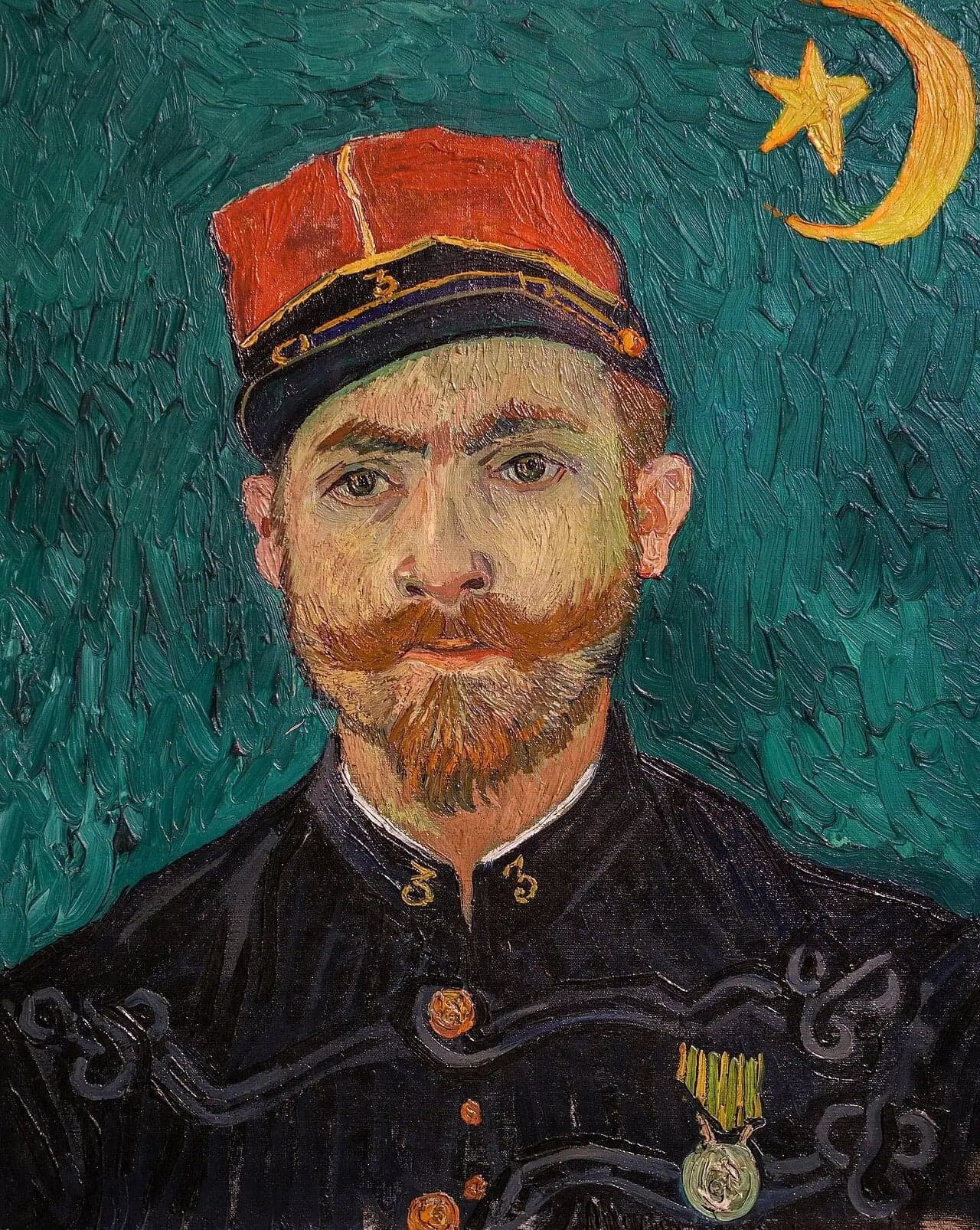
Portrait of Paul-Eugène Milliet
Scene depicted
This pictorial work features Paul-Eugène Milliet, a friend and colleague of Van Gogh, a central figure in his life during his time in Arles . The painting does not merely represent his face but weaves an atmosphere of tenderness and intimacy, revealing the psychological depths that a portrait can carry. The model's gaze, sincere and direct, invites the viewer to enter an intimate world where each brushstroke tells a story.
Historical context
Iconic work created in 1888 in Arles , Provence, Portrait of Paul-Eugène Milliet is part of the post impressionist movement, where color and light become the protagonists of the scene. It is in this vibrant and colorful atmosphere of southern France that Vincent van Gogh composed his painting, now preserved at the Kröller-Müller Museum . With delicate dimensions of 49 x 60 cm, this canvas highlights not only the subject but also a universe rich in emotions.
Place in the artist's career
Portrait of Paul-Eugène Milliet represents a crucial step in Van Gogh's career, marking his period of intense experimentation with color, as also evidenced by The Sunflowers and The Starry Night . This painting, both a reflection of his emerging genius and the emotional challenges he faced, presents an evolution of his style towards a more direct and personal expressiveness.
Anecdote
“Painting is a way of screaming what I cannot say” Van Gogh might have declared, as he painted this portrait in the heart of a spring awakened by the song of birds and the warmth of the sun. Inspiration bursts forth in a fleeting moment, crossing a friendly face, capturing the essence of the human soul on the canvas. This painting still resonates today as a living testimony of an indescribable emotional connection.