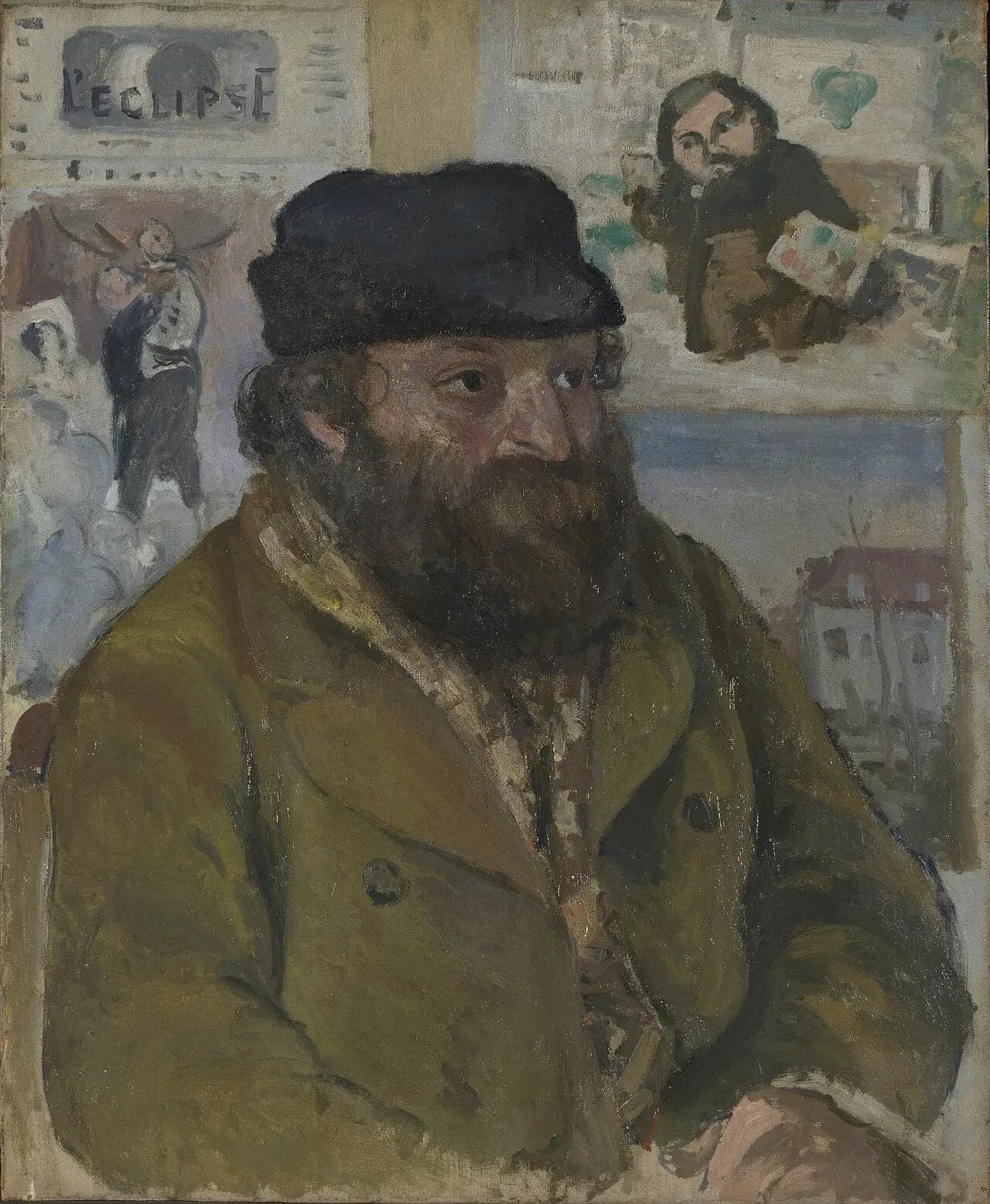
Portrait of Paul Cézanne
- Original dimensions
- 59.7 x 73 cm
- Museum
- National Gallery
- Year
- 1874
Scene depicted
This canvas reproduces the stoic image of Paul Cézanne, a man whose gaze betrays a depth of thought and a passion for art. The painting illustrates not only a friendship but also bears witness to the pivotal period of Impressionism , revealing the inner emotions of an artist with a complex soul. Pissarro skillfully uses light to bring his subject to life, thus translating the importance of individual expression within the movement.
Historical context
Created in 1874, in the heart of Paris, this painting is emblematic of the Impressionist movement, which resonates with technical innovations and vibrant emotions. This canvas is now located at the National Gallery, a famous museum in Washington, D.C., where it continues to be admired by art enthusiasts from around the world. The dimensions of the work, 59.7 x 73 cm, testify to the grandeur of a transformative artistic era.
Place in the artist's career
The Portrait of Paul Cézanne represents a significant milestone in the career of Camille Pissarro . As he explores different techniques, this painting fits into a period of maturity where he begins to refine his sense of color and composition. Alongside works such as The Circus and The Gardens of the Rue de la Réserve , this painting marks a stylistic transition towards a more introspective gaze.
Anecdote
“The painting must capture the soul of a moment,” said Camille Pissarro , evoking his relentless quest to immortalize light and human life. That morning, as he walked through the streets of Paris, an image of profound humanity presented itself to him: the familiar face of his friend Paul Cézanne, whose concentration and intensity spoke of art itself. It is the poignant emotion of this moment that found its echo in the masterpiece that is the Portrait of Paul Cézanne.