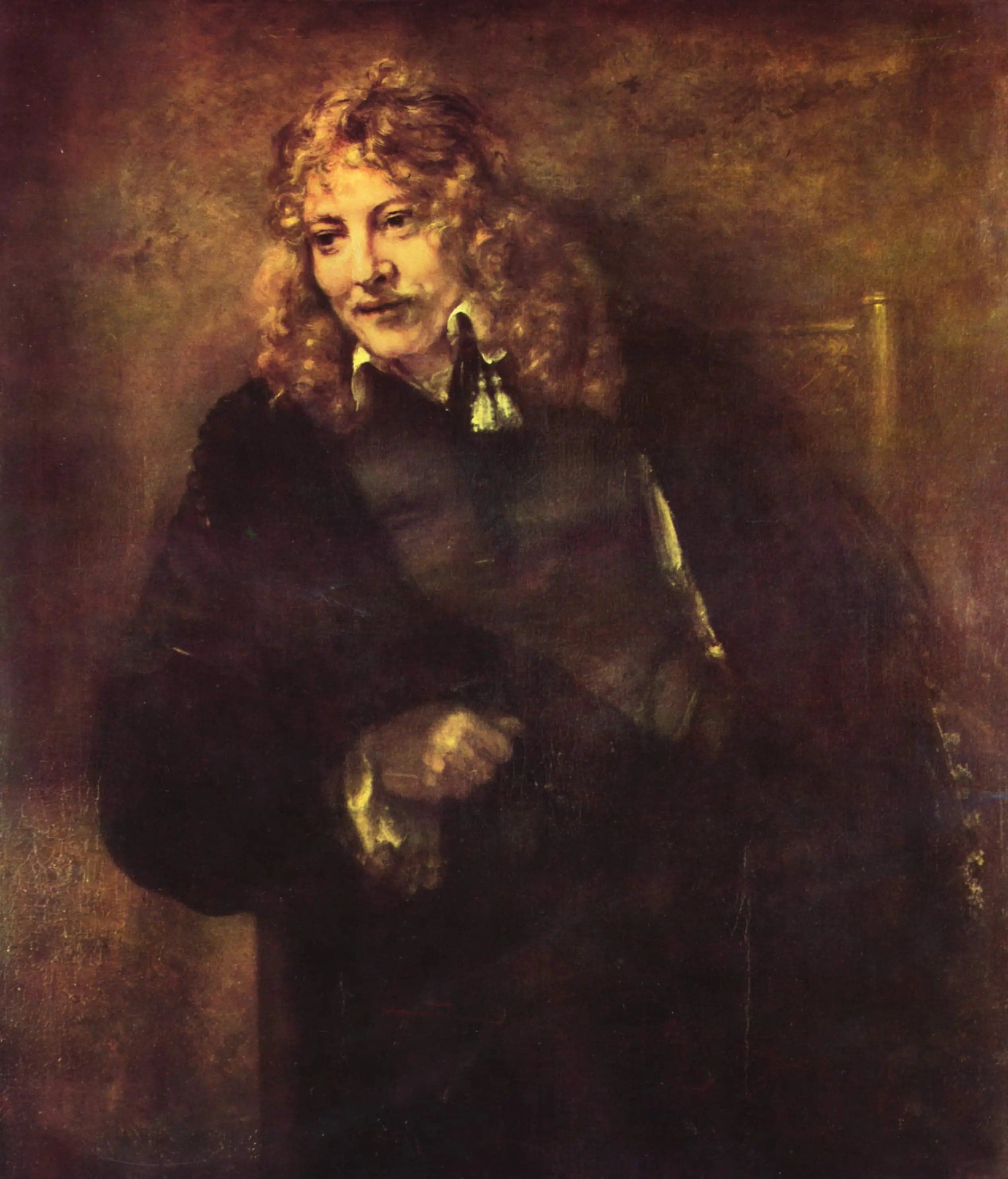
Portrait of Nicolas Bruyningh
- Original dimensions
- 91.5 x 106.8 cm
- Museum
- Gemäldegalerie Alte Meister
- Year
- 1652
Scene depicted
This canvas illustrates an intimate portrait of Nicolás Bruyningh, where the penetrating gaze and remarkable pose of the model capture the essence of his character. Rembrandt manages to transcend the simple portrait by offering a window into the soul of his subject. The meticulous details of the clothing and the subtle play of light on the face enhance the depth of the work, both intriguing and captivating.
Historical context
Created in 1652, in Amsterdam, at the heart of the Netherlands, this painting is part of the baroque movement. At the time, the Dutch were experiencing a period of economic and cultural prosperity. The canvas , now preserved at the Gemäldegalerie Alte Meister, reflects this wealth through its composition and lighting, typical of the genius of Rembrandt .
Place in the artist's career
The Portrait of Nicolas Bruyningh represents the pinnacle of baroque style in Rembrandt , at a time when he is refining his art. When placed alongside the famous painting “The Night Watch” and the “Portrait of Saskia,” a marked evolution in his approach to light and texture can be observed, combining intimacy and grandeur in his pictorial works.
Anecdote
“Art is the illusion of light,” Rembrandt might have said while contemplating his work. Imagine a winter morning, natural light filtering through the windows of a studio. It is in this setting that the inspiration for the masterpiece is born. The face of Nicolas Bruyningh, encountered in a quiet street, stands as a delicate invitation to contemplation.