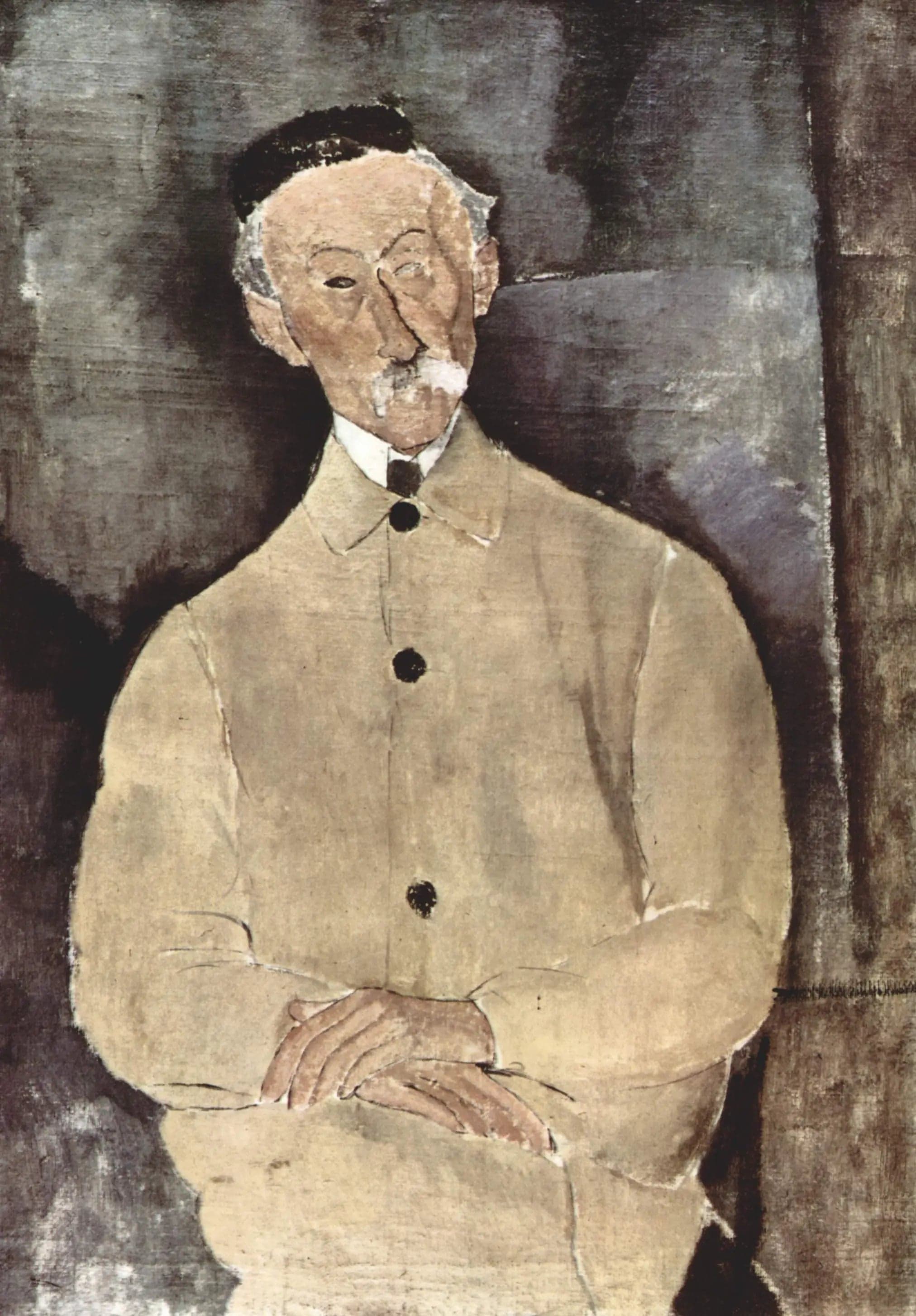
Portrait of Mr. Lepoutre
- Original dimensions
- 65 x 92 cm
- Museum
- Not specified
- Year
- 1916
Scene depicted
The painting “Portrait de Monsieur Lepoutre” depicts a man of rare elegance, captured in a contemplative pose. The artist, through this portrait, offers us a timeless glimpse into the character and intelligence of his model, sublimely expressed through elongated forms and an almost angelic face. The textures of the clothing and the play of light accentuate the mystery surrounding this iconic composition, transporting us into Modigliani's sensual universe.
Historical context
Created in Paris in 1916, in the heart of the modern era, the painting Portrait de Monsieur Lepoutre is part of the artistic movement of post-impressionism . It is in this vibrant city, where art and culture buzz, that Modigliani, an artist of Italian origin with a unique style, imagines this captivating pictorial work. The canvas , with its impressive dimensions, testifies to a period when experimentation and artistic individualism reach their peak, placing Modigliani at the forefront of this revolution.
Place in the artist's career
This painting stands as a symbol of the peak of Modigliani's style, representing both a pivotal moment and artistic maturation. It is alongside other iconic canvases like “La Femme à l’ombrelle” and “Portrait de Jeanne Hébuterne,” both witnesses to his technical evolution and the palpable emotion that emanates from his characters.
Anecdote
Modigliani, passionate about capturing the human soul, once declared: “Beauty lies in the curved lines of faces.” It is in a peaceful alley of Montparnasse, one April morning, that, fascinated by the charisma of Monsieur Lepoutre, he finds the inspiration for this masterpiece . The emotion present in this canvas invites deep contemplation, revealing a delicacy and unique sensitivity.