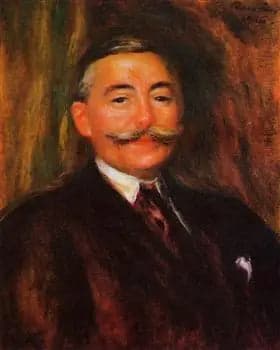
Portrait of Maurice Gangnat - Pierre
- Original dimensions
- 30.5 x 46 cm
- Museum
- Not specified
- Year
- 1916
Scene depicted
The painting “Portrait of Maurice Gangnat” reveals the face of a man in a moment of introspection, capturing not only the physical resemblance but also the soul of his subject. Through Gangnat's gaze, a profound human connection emerges, illustrating Renoir's skill in transcending mere representation to touch the heart of personality.
Historical context
Created in 1916, this painting is set in the dynamic context of Paris, an iconic city of impressionist art. This canvas , a product of various influences from the impressionist movement, echoes a time when light and movement redefined the components of pictorial art. The current location of this canvas remains obscure, but its essence continues to radiate within circles of art enthusiasts.
Place in the artist's career
This painting , painted in 1916, marks a milestone of maturity in Renoir's career, merging technique and emotion. Accessible and deepening his standards, it parallels other iconic paintings like “The Bathers” and “Luncheon of the Boating Party,” reflecting the relentless evolution of his style.
Anecdote
“Beauty lies in the details,” Renoir said, inspired by the faces he encountered during his morning walks, cradled by the soft light of a Parisian spring. This quote resonates strongly in the genesis of this masterpiece , where each brushstroke testifies to a deep admiration for humanity.