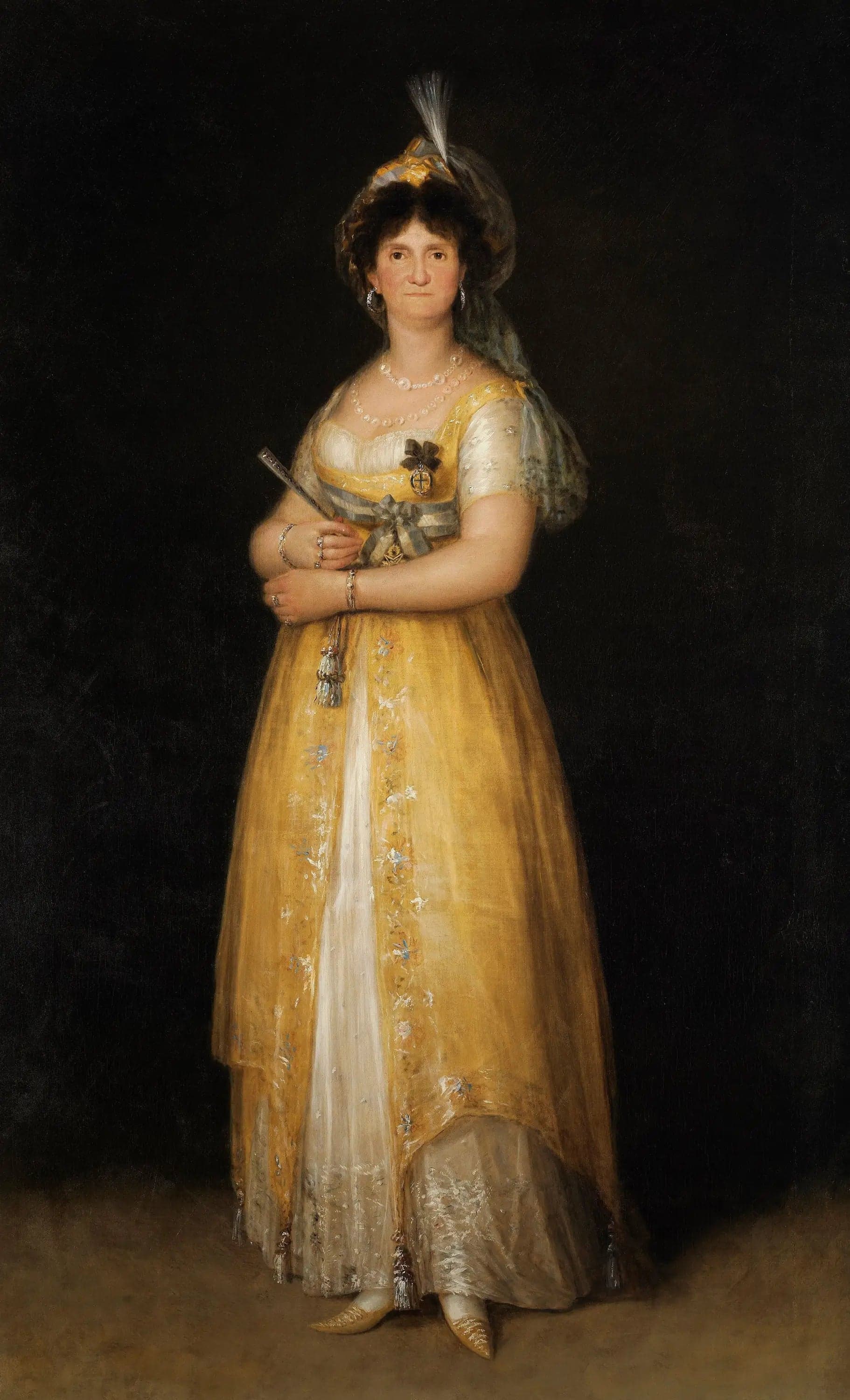
Portrait of Marie-Louise of Parma
- Original dimensions
- 124 x 202 cm
- Museum
- Capodimonte Museum
Scene depicted
This masterpiece unveils the majesty of Marie-Louise of Parma, adorned in a velvet gown of vibrant hues, a setting of timeless grace. In the painting, Goya highlights the charismatic personality of his subject, stylizing her with an aura that is both royal and accessible. The delicate pose and candid gaze convey intimacy while capturing the exercise of power and the responsibilities that accompany it.
Historical context
Created in 1800, this iconic painting is rooted in the city of Naples, Italy, a period when Goya stands out as one of the masters of romanticism . The artistic context of this time reflects a brilliant versatility, oscillating between classicism and the beginnings of romanticism . Today, the painting is housed in the Capodimonte Museum, where it continues to fascinate generations of admirers.
Place in the artist's career
The Portrait of Marie-Louise of Parma represents a turning point in Goya's career, marking a period of creative maturity. Through works such as La Maja desnuda and The Executions of May 3rd, one can observe an evolution in painting technique and the exploration of the human condition. This painting stands as a stylistic peak, where the expressiveness of emotions is at its height.
Anecdote
“Every face tells a story, a hidden secret” Goya might have said while admiring his own canvas, inspired by the sparkling gaze of Marie-Louise, then duchess. This moment of escape, a sunny morning at court, was the cradle of this artwork, where each brushstroke reveals a subtlety of the human soul.