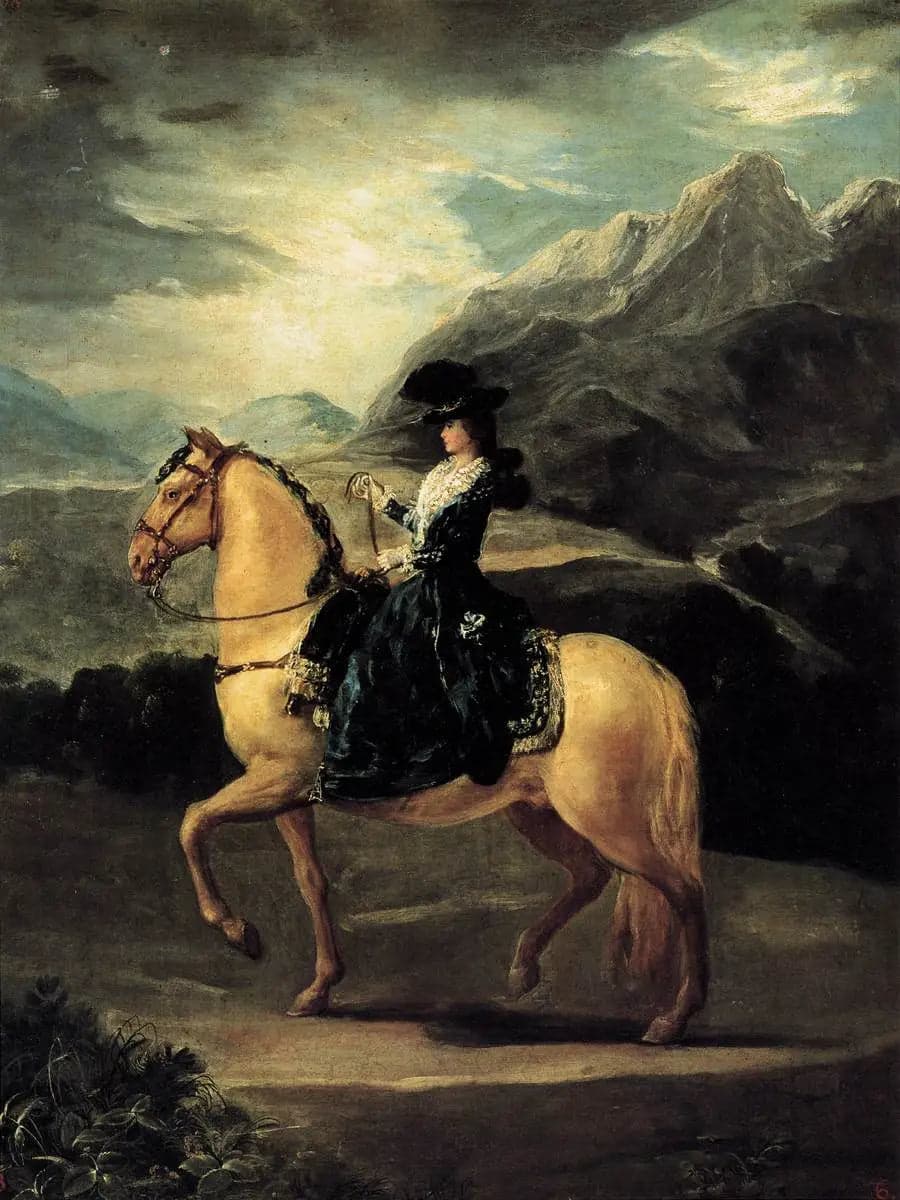
Portrait of María Teresa de Vallabriga on Horseback
- Original dimensions
- 61.7 x 82.5 cm
- Museum
- Uffizi Gallery
- Year
- 1783
Scene depicted
In this painting, Goya offers us a unique portrait of María Teresa de Vallabriga, capturing the elegance of an aristocrat on horseback. The dynamic composition emphasizes not only the stature of the individual but also the deep connection between noble and nature. The details of the harness, the balanced curves of the horse, and the tender environment come together to pay tribute to a time when nobility and nature coexisted in harmony.
Historical context
Created in 1783, this painting is emblematic of a vibrant and creative era, located in Madrid. Goya, a major figure of neoclassicism, illustrates here the great nobility of Spain. His canvas is currently housed in the Uffizi Gallery, a must-see of Florentine culture, testifying to the artistic heritage of the 18th century.
Place in the artist's career
This canvas is situated at a pivotal moment in Goya's career, where he experiments with new techniques while asserting his unique style. Like his early paintings such as “La Maja desnuda,” and his darker works like “The Disasters of War,” this portrait reflects his evolution, oscillating between realism and deep emotion.
Anecdote
“The essence of a noble is captured in the moment, listening to the song of birds at dawn.” This quote might remind Goya of his inspiration, a sunny morning when he observed María Teresa, elegantly perched on her horse, full of grace and beauty. This pictorial work embodied by the canvas reveals a powerful intimacy while highlighting the splendor of nobility.