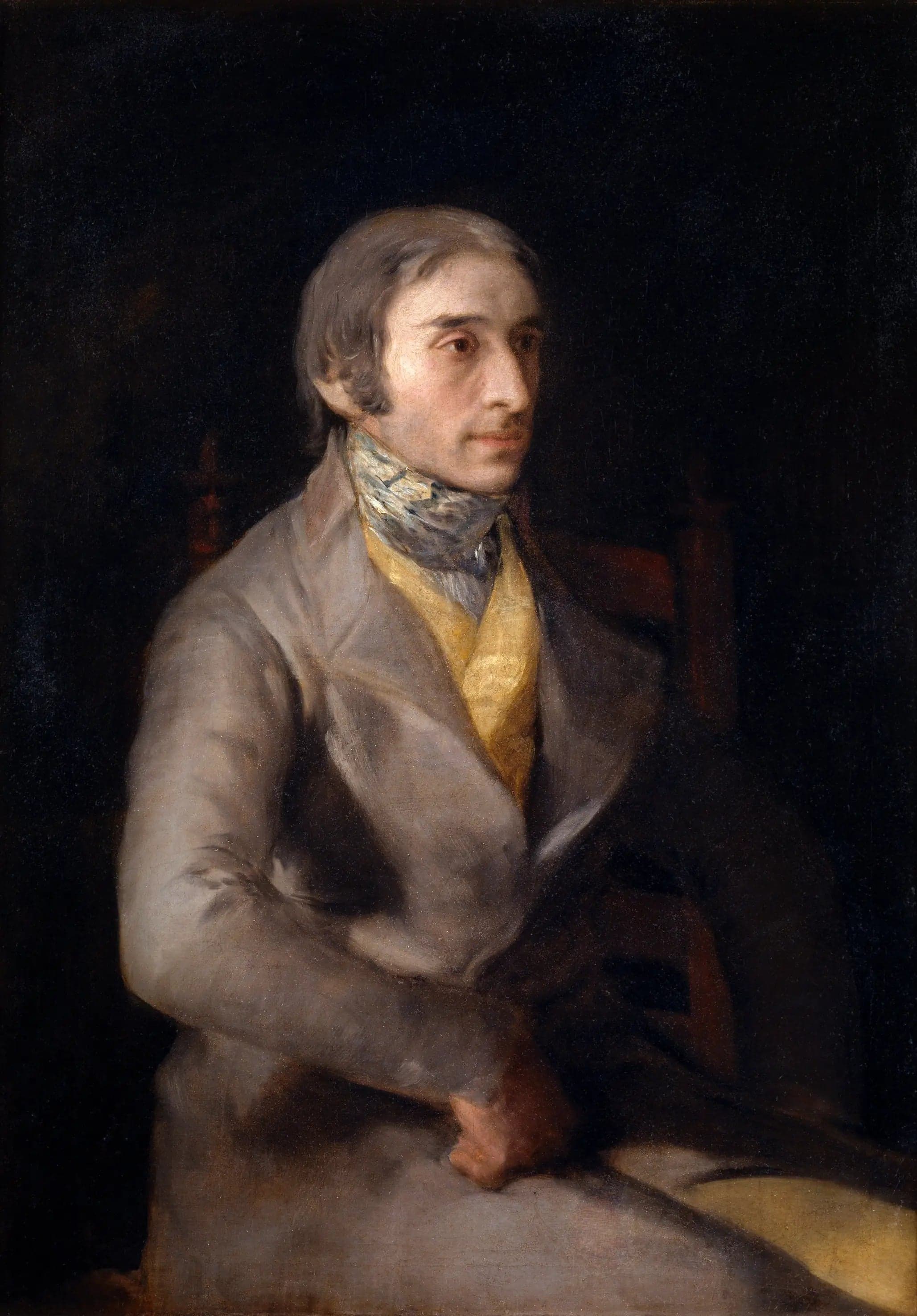
Portrait of Manuel Silvela
- Original dimensions
- 68 x 95 cm
- Museum
- Prado Museum
- Year
- 1809
Scene depicted
The painting “Portrait of Manuel Silvela” depicts an intimate and thoughtful scene. Silvela, an influential statesman, is portrayed with striking dignity, his eyes reflecting both the strength of his thought and a poignant sensitivity. The composition emphasizes a build that is both robust and intellectual, embodying the ideals of his time while revealing the nuances of his character.
Historical context
Created in 1809, this painting is emblematic of the golden age of Spanish painting in Madrid. Francisco de Goya , a pillar of the romantic movement, captured a time of political and social upheaval, where the lights of the Age of Enlightenment promised radical change. Currently, this painting is located in the Prado Museum, where it enchants visitors with its humanity and intensity. Its dimensions, 68 by 95 centimeters, make it a work of striking presence.
Place in the artist's career
This masterpiece is situated at a crucial crossroads in Goya's career. It marks a period of maturity, where his style becomes more introspective, echoing the social tensions he perceived around him. Alongside the famous “Nude Maja” and “The Third of May 1808,” this painting illustrates the evolution of his technique and artistic vision, oscillating between classical portraiture and personal expression.
Anecdote
“In every face lies a story, and every story is a reflection of time.” This phrase could be attributed to Goya, who, inspired by the golden light of a spring morning, crossed paths with the weathered face of Manuel Silvela in a quiet alley. This fleeting moment infused a soul into his canvas , revealing the depth of human feelings.