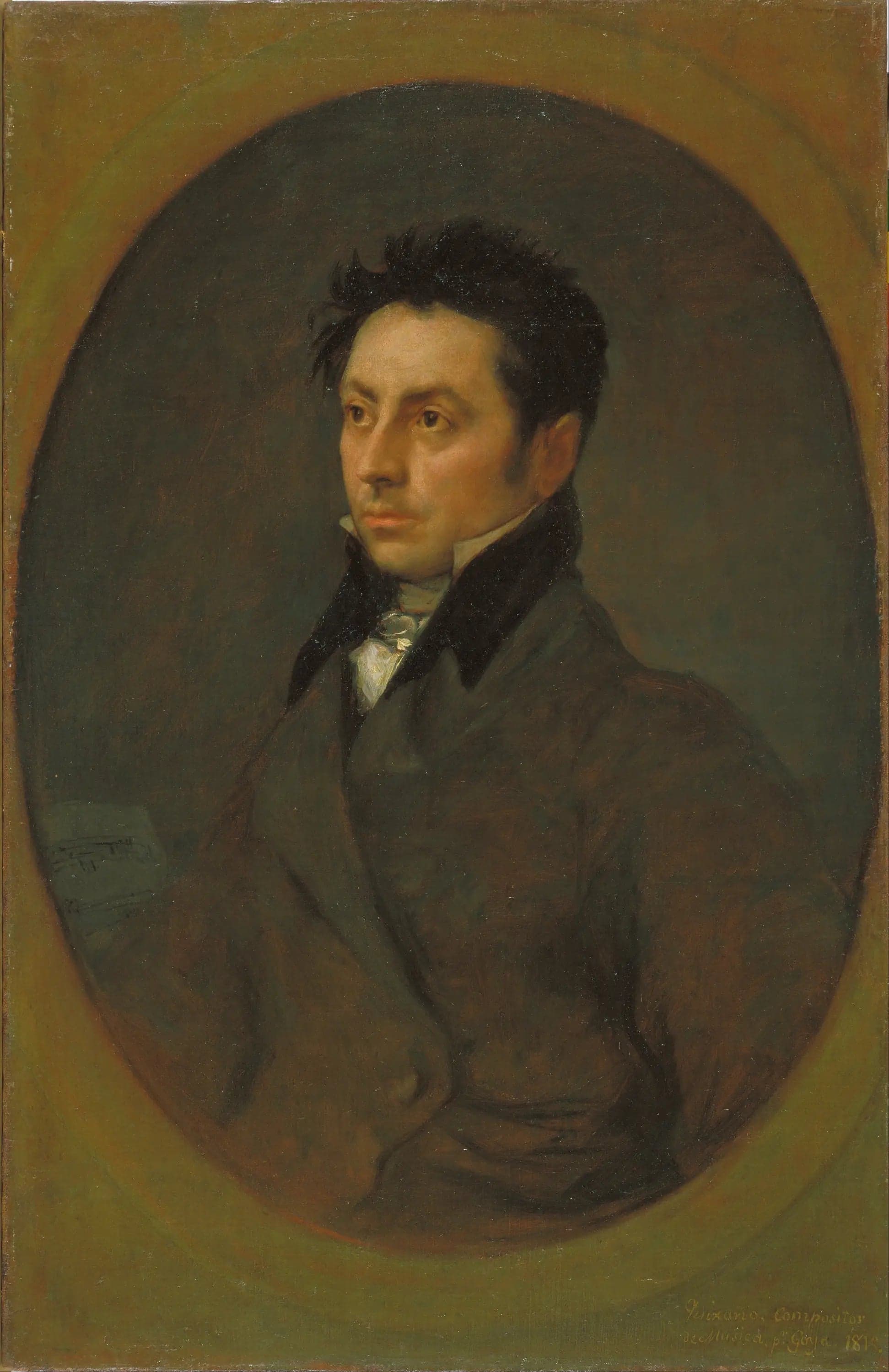
Portrait of Manuel Quijano
- Original dimensions
- 565 x 868 cm
- Museum
- National Art Museum of Catalonia
- Year
- 1815
Scene depicted
In this painting, Goya offers us a penetrating gaze at Manuel Quijano, a man whose presence and character are revealed by nuances of light and shadow. The scene, charged with palpable intimacy, invites us to explore the psychology of its subject, while each meticulously integrated detail contributes to the lively atmosphere of this pictorial composition.
Historical context
Created in 1815, this iconic painting is at the heart of romantic Spain , during a time of cultural effervescence. At this period, Francisco de Goya , a leading figure of the artistic movement, asserts himself as a key painter in the transition from neoclassicism to romanticism . His work, currently preserved at the National Art Museum of Catalonia in Barcelona, embodies a time when each brushstroke resonates with subtle intelligibility, through a canvas of impressive dimensions.
Place in the artist's career
Within Goya's career, this painting represents a pivotal period, where the artist asserts his personal style. In parallel with other iconic works such as “The Maidens” and “The Executions of May 3, 1808,” this masterpiece illustrates his evolution both technically and emotionally, thus shaping his artistic legacy.
Anecdote
“The face of a man can reveal deeper truths than words themselves.” This reflection from Goya sheds light on the genesis of his masterpiece , conceived one spring morning in his studio, where soft light streamed through the windows, caressing the features of his model Manuel Quijano. The vibrant emotion of this moment is palpable in the canvas, like an echo of the soul.