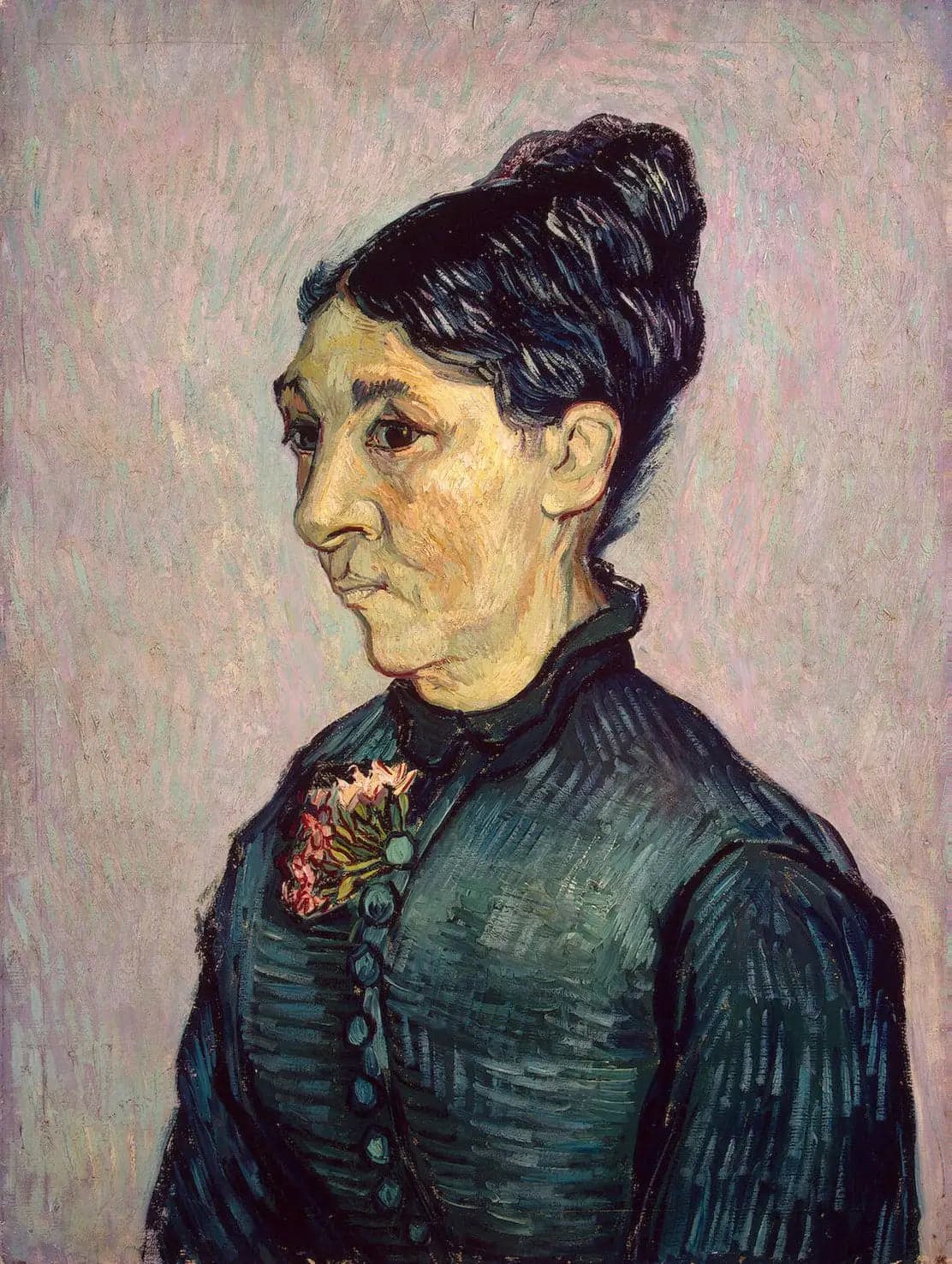
Portrait of Madame Trabuc
Scene depicted
The painting “ Portrait of Madame Trabuc” reveals the intimacy and elegance of a woman, highlighting her pensive expression and her inclusion in the vibrant and swirling universe of Van Gogh. Every detail, from the dark to the bright, converses with human emotions, making the pictorial work deeply alive.
Historical context
Created in 1889, this painting is the result of a period of intense creativity for Vincent van Gogh , then located in Saint-Rémy-de-Provence , France. This canvas is delicately rooted in the post-impressionist movement, characterized by a search for subjective expressions through color and form. Today, this painting resides at the Hermitage Museum in Saint Petersburg, boasting elegant dimensions of 48 x 63.7 cm.
Place in the artist's career
This painting stands as a turning point in Van Gogh's career, illustrating his growing mastery of color and light. It is adorned with the essence of a promising beginning, similar to works such as “ The Starry Night ” and “ The Sunflowers ,” testifying to both technical and emotional evolution in his artistic journey.
Anecdote
“Painting is a voice of the soul,” Van Gogh once said. Inspired by a bright morning, he crossed the contemplative gaze of Madame Trabuc, whose serenity triggered an avalanche of colors on his palette. This painting evokes not only the face of his model but also captures the essence of a moment of eternity.