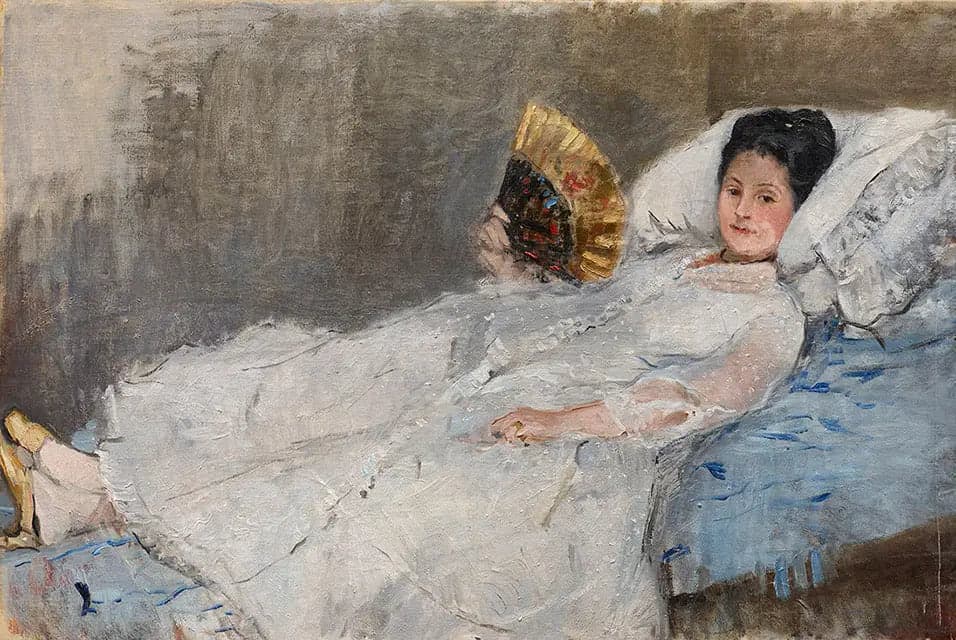
Portrait of Madame Hubbard
- Original dimensions
- 81 x 50.5 cm
- Museum
- Ordrupgaard
- Year
- 1874
Scene depicted
The painting “Portrait de Madame Hubbard” depicts a woman of refined style, dressed in white, seemingly bathed in the light of a delicate halo. This fleeting moment is transcribed with particular tenderness, revealing the nuances of the maternal personality that Morisot wished to immortalize. This pictorial work is an ode to femininity and its complexity, capturing the viewer with the softness and intensity of her gaze.
Historical context
Created in 1874, this painting from the studio of Berthe Morisot perfectly fits within the lineage of the impressionist movement, radiating in Paris, the capital of arts, where avant-garde and tradition intertwine. At a time when art is experiencing an aesthetic revolution, every brushstroke of this masterpiece testifies to the quest for ephemeral beauty. Currently housed in the Ordrupgaard museum, this painting magnifies a soft and vibrant light, capturing a moment of life frozen in time.
Place in the artist's career
This painting is much more than a simple representation; it marks a turning point in Morisot's career, then at the height of her artistic expression. Echoing other works such as “The Cradle” and “Reading,” this piece illustrates her evolution towards increasingly bold compositions, blending intimacy and universality.
Anecdote
“Light is my muse and shadow my accomplice,” said Morisot, evoking the thrill of inspiration she felt while painting this masterpiece . Imagine the scene: a gentle spring morning, birds are singing, and the scent of flowers rises in the fresh air. It is in this idyllic setting that she meets the gaze of Madame Hubbard, a muse revealing a deep sensitivity, ready to be celebrated on her canvas .
Major exhibitions
Impressionist Treasures