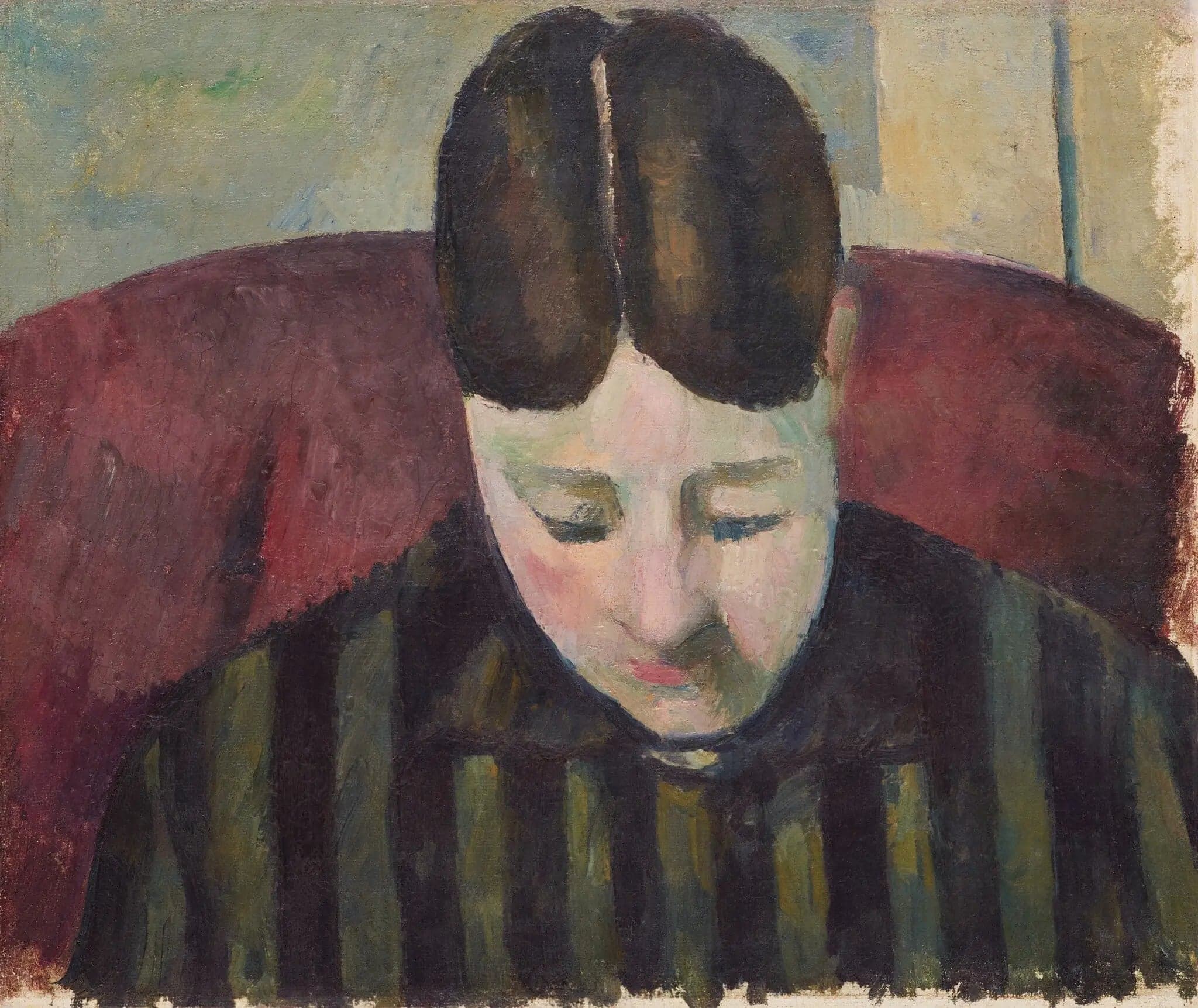
Portrait of Madame Cézanne
- Original dimensions
- 38.5 x 46.5 cm
- Museum
- musée d'Orsay
- Year
- 1887
Scene depicted
The canvas “Portrait de Madame Cézanne” immerses us in the intimacy of Cézanne's life, presenting his wife, Hortense, with a rare psychological depth. The delicate features of her face blend with a vibrant background, echoing how the artist weaves emotions through his canvas .
Historical context
Created in 1887, in the artistic city of Paris, this painting is emblematic of the post-impressionist movement. At that time, Cézanne sought to synthesize light and color with an innovative style. The canvas , now displayed at the musée d'Orsay , perfectly captures its vibrant atmosphere and pictorial boldness.
Place in the artist's career
This painting marks a turning point in Cézanne's career, signifying a period of maturity. It is part of a series of portraits that includes other canvases like “The Card Player” and “The Woman with the Shawl,” which testify to a technical and emotional evolution, creating a bridge between the light and shadow of his works.
Anecdote
“In every face, I find a story to tell,” said Cézanne. This painting was born from a sunny morning, where the painter crossed the gaze of his muse, Madame Cézanne. Her face, imbued with delicacy and melancholy, captures the very essence of intimacy, connecting the artist to his muse in a suspended moment.