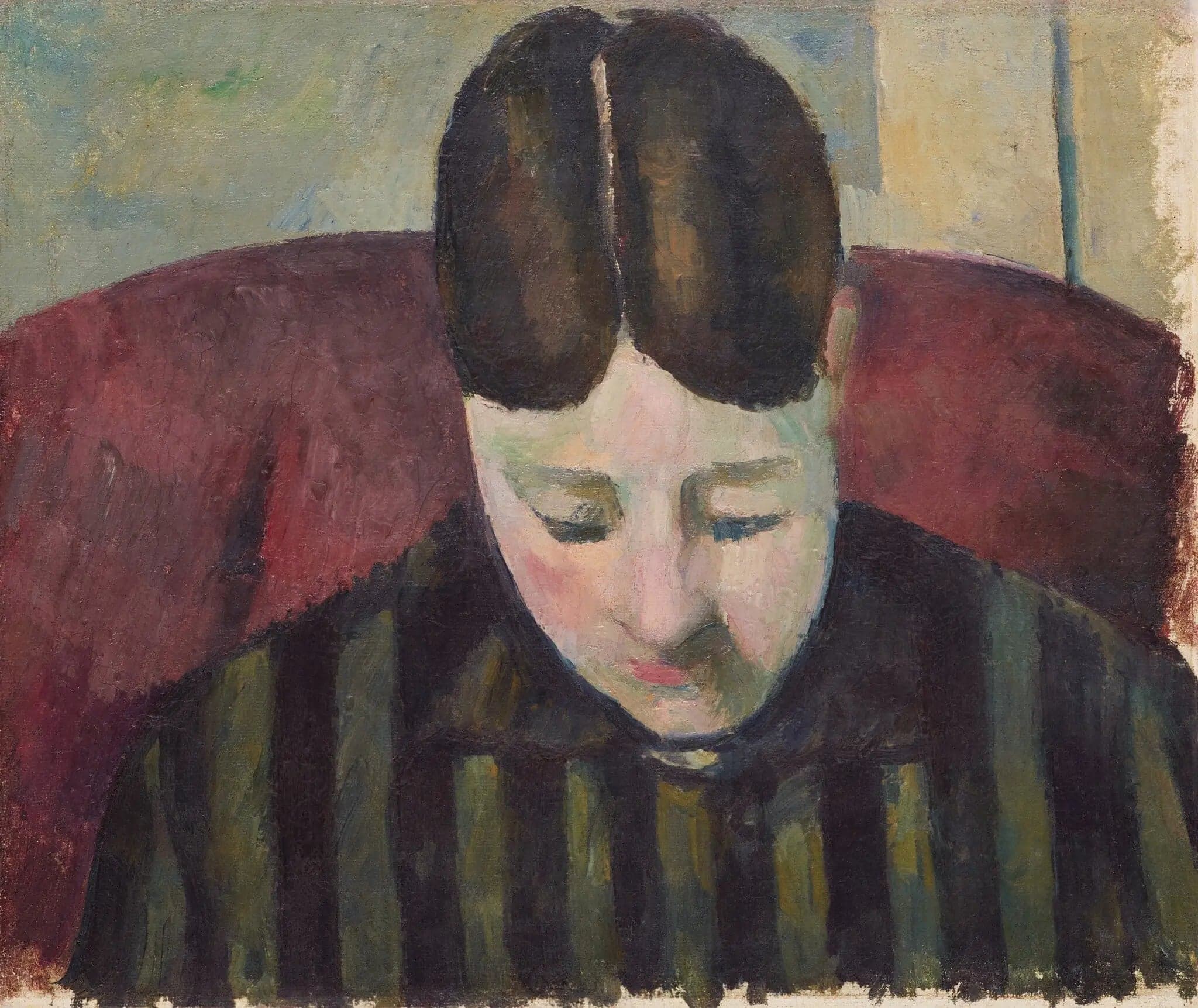
Portrait of Madame Cézanne
- Original dimensions
- 38.3 x 46 cm
- Museum
- Philadelphia Museum of Art
- Year
- 1885
Scene depicted
The painting “Portrait of Madame Cézanne” captures the very essence of the intimate relationship between the artist and his model. In the setting of their home, Madame Cézanne, a face imbued with serenity, reflects a suspended moment, where the softness of the hour and the gentle light flood the room, enveloping the viewer in a warm atmosphere.
Historical context
Created in 1885, this painting is emblematic of the vibrant context of post-impressionist France. It stands as a witness to the artistic evolutions that permeate the city of Aix-en-Provence, the birthplace of Cézanne. The canvas , currently housed at the Philadelphia Museum of Art , reflects the struggle between light and shadow, a fundamental characteristic of its time.
Place in the artist's career
This masterpiece positions itself as a centerpiece in Cézanne's stylistic evolution, revealing his unique approach to portraiture. Alongside “The Card Players” and “Mont Sainte-Victoire,” “Portrait of Madame Cézanne” demonstrates his transition from realistic representation to a more personal and emotional interpretation of the subject.
Anecdote
“Nature is my most faithful muse,” Cézanne is said to have declared in a moment of introspection, inspired by the landscapes and faces of his beloved Provence. That morning, as he painted his wife, he felt the depth of love and creativity intertwining in every brushstroke, bringing this canvas to life.