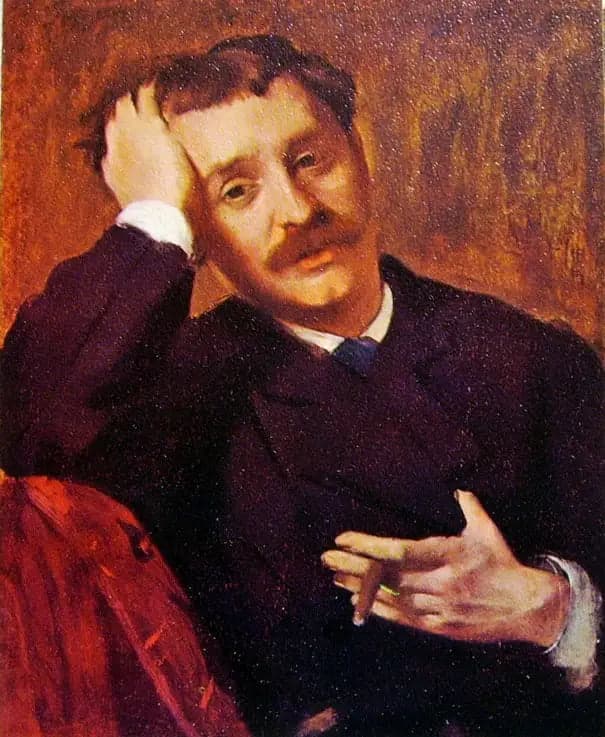
Portrait of Lorenzo Pagans
- Original dimensions
- 49 x 59 cm
- Museum
- National Gallery in Prague
- Year
- 1882
Scene depicted
The painting “Portrait of Lorenzo Pagans” immerses us in the intimacy of the character. Lorenzo, a talented portraitist himself, stands with quiet nobility, his evocative gaze capturing the viewer's attention. The scene, bathed in light, evokes a peaceful atmosphere, where each brushstroke seems to whisper a story, that of an artist at a crossroads.
Historical context
Created in 1882, this painting is at the heart of Paris, a city of excitement and artistic creativity. Edgar Degas , a key figure of the Impressionist movement, captures the essence of society in his time through this poignant canvas . Currently exhibited at the National Gallery in Prague , this masterpiece reveals the feelings and atmospheres of an era in full metamorphosis.
Place in the artist's career
This canvas holds a prominent place in Degas's career, revealing a major stylistic turning point. Alongside “The Dance Class” and “The Ballet Rehearsal,” “Portrait of Lorenzo Pagans” testifies to the artist's evolution towards a quest for more personal expression, away from academic constraints.
Anecdote
“Beauty is not about perfection, but about the authenticity of a captured moment.” These words, spoken by Degas, resonate with the genesis of this masterpiece . Inspired by an unexpected encounter, the artist depicts Lorenzo Pagans in a moment of grace, one April morning, where the soft light caresses his face. This canvas thus becomes a precious testimony of the moment, filled with emotions.