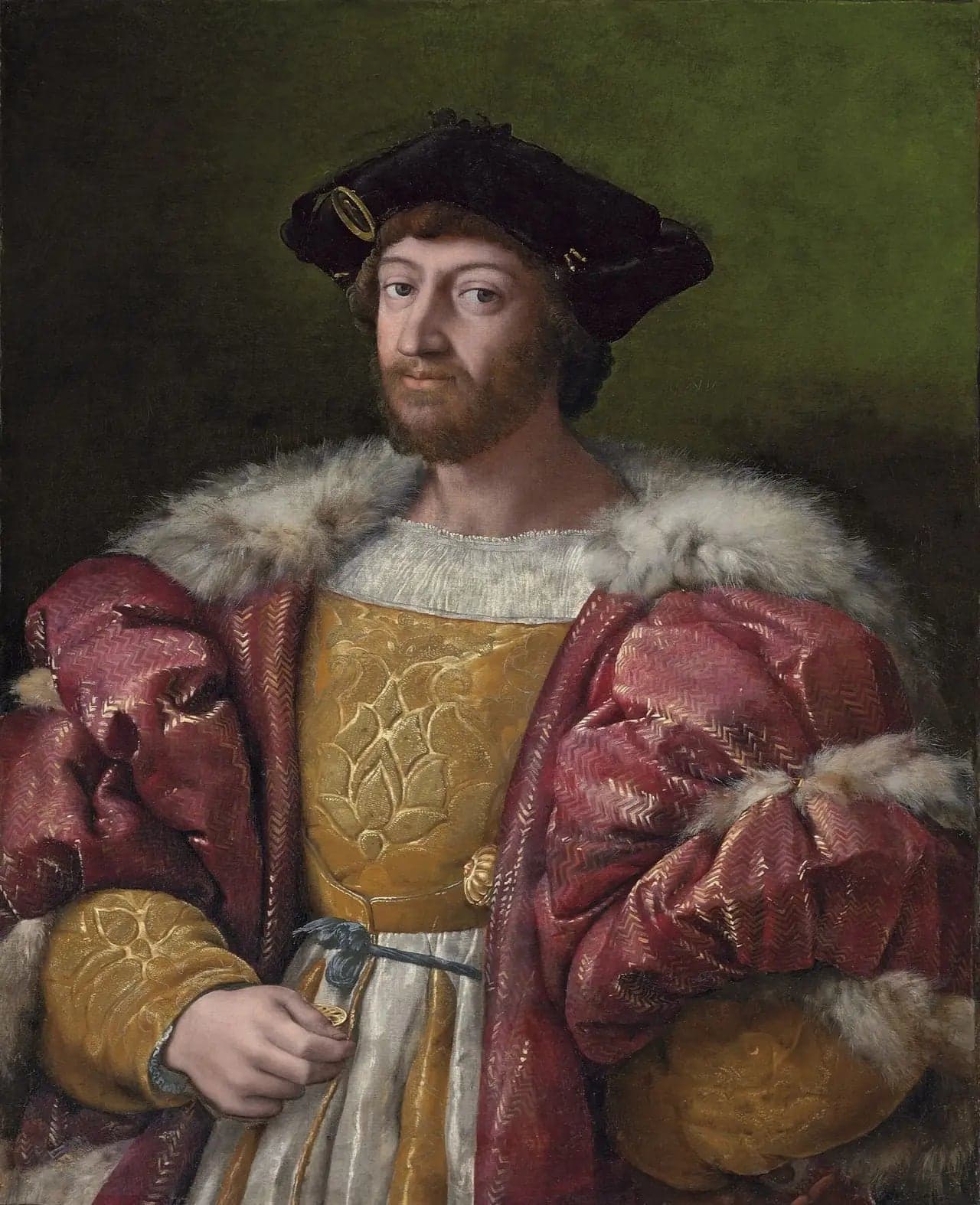
Portrait of Lorenzo de' Medici, Duke of Urbino
- Original dimensions
- 79 x 97 cm
- Movement
- High Renaissance
- Museum
- Not specified
- Year
- 1517
Scene depicted
In the painting "Portrait de Laurent de Médicis, duc d'Urbino," Raphael presents with profound delicacy the duke, dressed with an elegance that is both simple and refined, paying homage to his aristocratic roots. Laurent's penetrating gaze captures the viewer, while the details of his attire and the nuances of his pose testify to impressive technical mastery, thus offering a glimpse into the complex personality of this man of power.
Historical context
Created in 1517, this canvas emblematic finds its roots in the splendor and artistic effervescence of Florence during the High Renaissance . At the heart of this golden age, the painting captures a living essence of the complex being that was Laurent de Médicis, a central figure in Italian culture. Although the location of his current residence is not specified, this painting remains a true treasure of European artistic heritage.
Place in the artist's career
This painting constitutes a major milestone in the career of Raphael , illustrating his ascent to a stylistic peak. At this time, he had already created remarkable works such as "The Sistine Madonna" and "The School of Athens." Each of these paintings , including the "Portrait de Laurent de Médicis," testifies to the artist's evolution towards a quest for perfection and harmony.
Anecdote
Raphael is said to have said: "Art must be an ode to eternal beauty." This masterpiece was shaped at the moment when the morning light caressed the city, illuminating a street filled with promises. Inspired by a face encountered, the artist was able to translate through his painting the aspirations and grandeur of the subject, making the painting an ode to humanity.