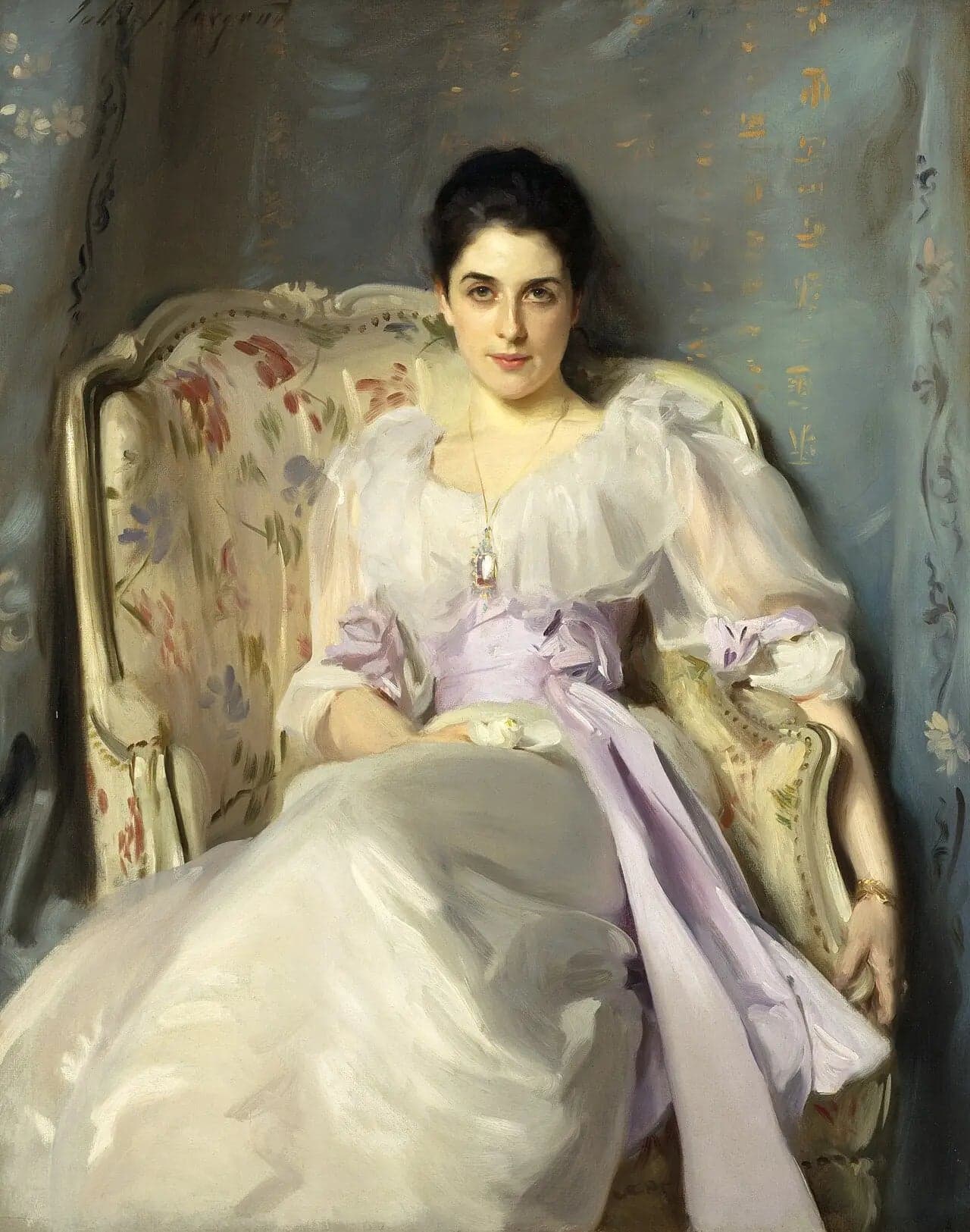
Portrait of Lady Agnew of Lochnaw
- Original dimensions
- 101 x 127 cm
- Museum
- National Gallery of Scotland
- Year
- 1892
Scene depicted
The painting depicts Lady Agnew, a woman of undeniable grace, seated in an armchair, enveloped by drapes of moiré silk, while a peaceful landscape unfolds in the background. Her captivating gaze and enigmatic smile invite the viewer into her world, while the canvas resonates with narrative and emotional details, testifying to Sargent's keen observation.
Historical context
Created in 1892 in Edinburgh, this painting is emblematic of the realism and portraiture movement of the late 19th century. The painting, now housed in the National Gallery of Scotland, challenges the viewer with its striking presence and particular elegance that celebrates a time rich in artistic and cultural innovations.
Place in the artist's career
The Portrait of Lady Agnew of Lochnaw marks a turning point in Sargent's career, definitively establishing his status as a master of portraiture. By placing it in dialogue with other compositions such as Madame X and Portrait of Misses Mabel and Rosamund , it is possible to discern a stylistic evolution, moving towards a bolder exploration of human emotions and light.
Anecdote
“In every face, there is a story hidden, and it is the role of the artist to awaken it.” It was in a room bathed in soft light, one spring morning in London, that Sargent revealed his inspiration for this masterpiece . The encounter with Lady Agnew, a delicate and charismatic figure, marked the beginning of a pictorial adventure, revealing the emotional strength that radiates from the painting .