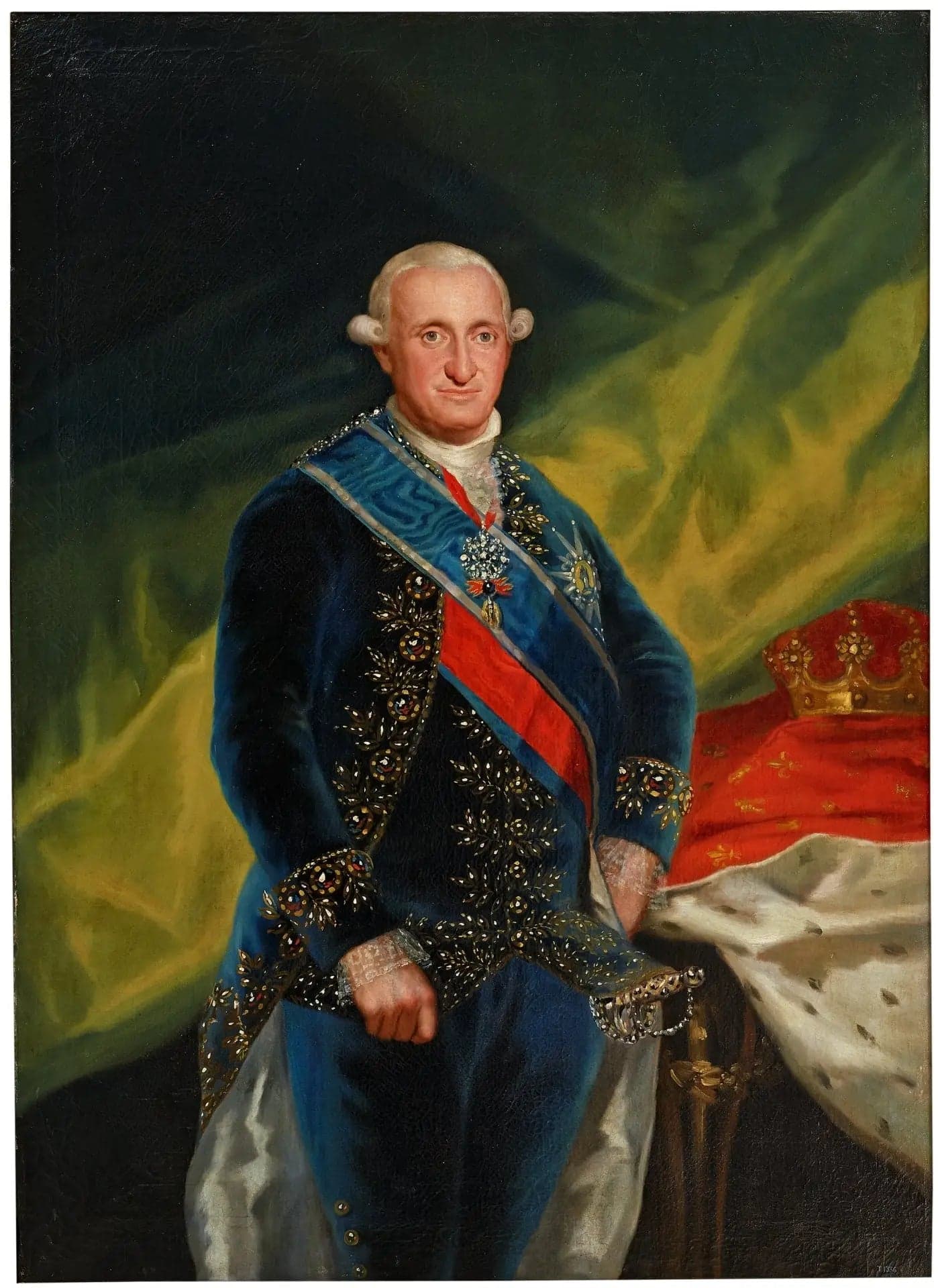
Portrait of King Charles IV
- Original dimensions
- 110 x 152 cm
- Museum
- Prado Museum
- Year
- 1790
Scene depicted
This canvas depicts King Charles IV, surrounded by his court, in a way that transcends the simple royal portraits of the time. Goya manages to capture not only the physical stature of the monarch but also his essence, his doubt, through the gazes of the secondary characters that flank him. Every detail of this masterpiece tells a story, revealing the nuances of the soul of a powerful yet vulnerable man.
Historical context
Created in 1790, this painting is located in the heart of Madrid, Spain, at a time marked by political and social upheaval. This iconic work, inscribed in the movement of romanticism , captures the face of King Charles IV, a central figure of his time. The canvas , currently preserved in the Prado Museum, evokes a period of cultural flourishing where art and royalty intertwine. Dimensions: 110 x 152 cm, an imposing work that calls for contemplation.
Place in the artist's career
The portrait of King Charles IV is situated at a pivotal moment in Goya's career, revealing an artist at the crossroads of tradition and innovation. Compared to “La Maja Desnuda” and “The Executions of May 3, 1808,” this canvas shows an evolution in the representation of human figures, blending realism and symbolism .
Anecdote
“The truth hides behind every gaze.” These words resonate like an echo of our time. Francisco de Goya , somewhere in his studio, inspired by the gentle rays of a spring morning, allows himself to be inspired by the very essence of his subject. The painting of King Charles IV, both majestic and stripped down, is the result of deep introspection and palpable humanity.