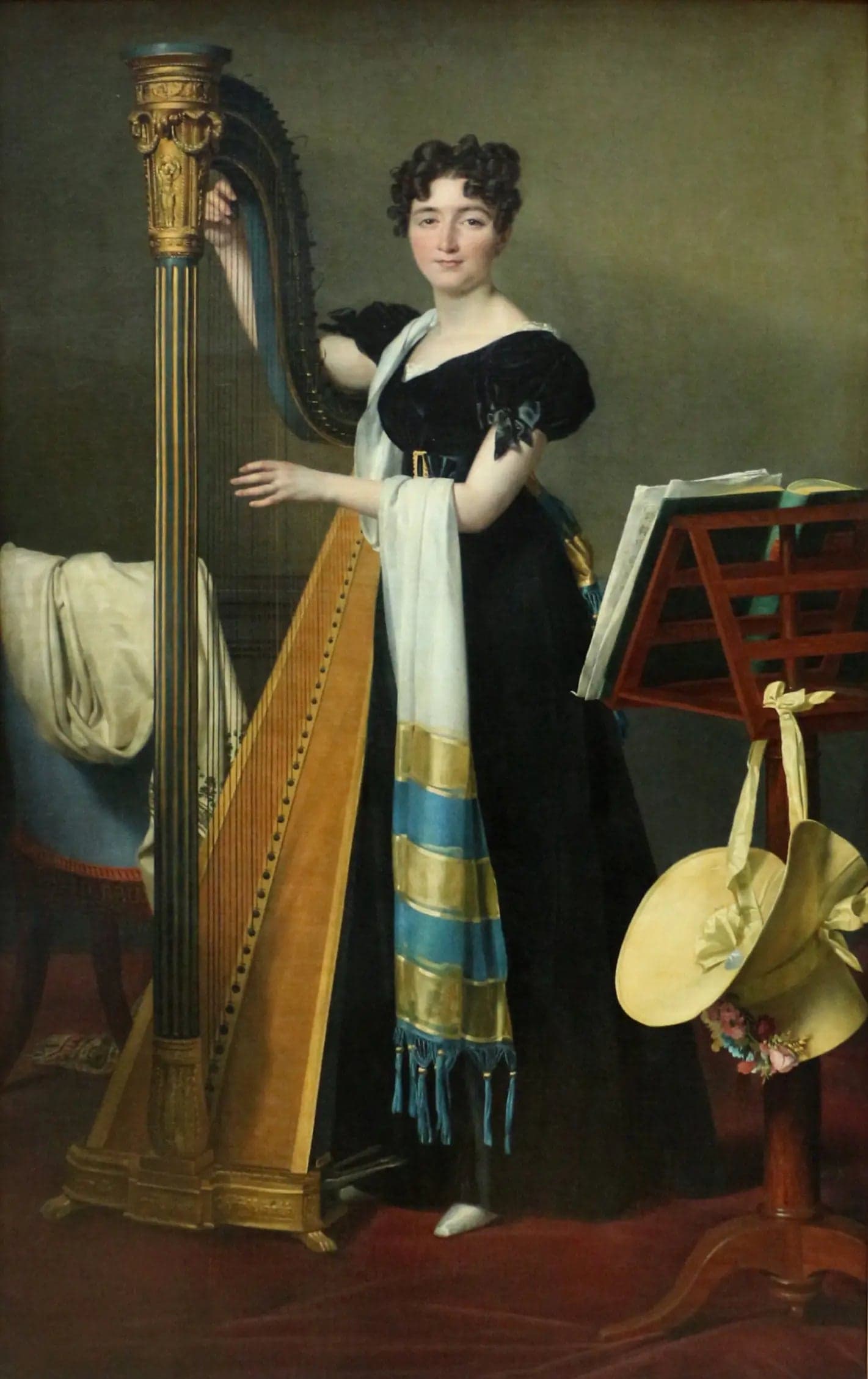
Portrait of Juliette de Villeneuve - Jacques
- Original dimensions
- 123 x 197 cm
- Museum
- Gallery of Time
- Year
- 1824
Scene depicted
In this pictorial work, Jacques-Louis David chooses to depict Juliette de Villeneuve with striking delicacy and precision. Juliette, a charismatic figure of her time, is dressed in an elegant gown, her posture captured in a moment of reflection. The gaze of the muse, both tender and penetrating, invites the viewer into a silent dialogue, tinged with mystery. The composition of the painting evokes the refinement of an era where art and life intersected, each meticulously crafted detail testifying to David's artistic genius.
Historical context
Created in 1824 in Brussels, this painting is at the heart of neoclassicism , a movement that advocates a return to the classical forms of Greece and Rome. It is in this context that Jacques-Louis David , the undisputed master of the time, created this canvas that resonates with values of elegance and rigorous composition. This iconic painting , displayed at the Gallery of Time, evokes the richness of a period where every brushstroke is laden with history.
Place in the artist's career
This painting fits into David's artistic maturity. It closely follows his masterful achievements such as “ The Oath of the Horatii ” and “ The Death of Socrates ”. These paintings show an evolution, both technical and emotional, in David's works, which, through each brushstroke, demonstrate an increasingly refined mastery and a touching empathy towards his subjects.
Anecdote
Jacques-Louis David is said to have stated: “Every portrait is a story in itself, a glimpse into the soul of those who lived.” The painting of Juliette de Villeneuve thus took shape one morning, at the turn of a peaceful street in Brussels. The artist is inspired by the presence of a muse, capturing in her gaze a story of grace, resilience, and timeless beauty, where every nuance of the painting resonates like a gentle breath.