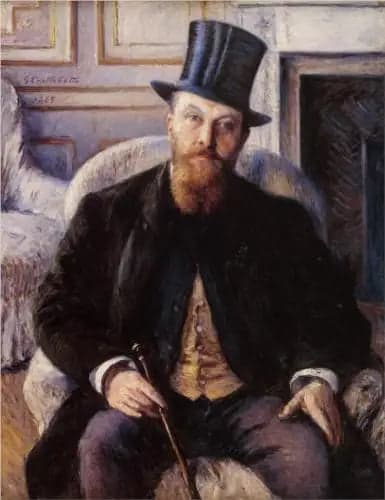
Portrait of Jules Dubois
- Original dimensions
- 89 x 117 cm
- Museum
- Not specified
- Year
- 1885
Scene depicted
The painting “Portrait de Jules Dubois” depicts a man with striking features, whose gaze seems to capture the nuances of his personality. The soft light that caresses his face testifies to the intimacy of the moment, inviting the viewer to engage in a silent dialogue with the subject.
Historical context
Created in 1885, in the vibrant setting of Paris, this painting is part of the Impressionist movement that revolutionizes artistic perception. The canvas manages to capture an urban essence, a frozen moment of faces, emotions of that time. Currently, the painting is not displayed in a specific museum, making it all the more precious in the register of exceptional artists.
Place in the artist's career
Positioned midway through his career, this painting represents both a technical maturation and a deep expression of portrait art. Compared to “Les Oiseaux de Paris” and “La Gare Saint-Lazare,” one perceives Caillebotte's stylistic evolution, moving from landscape study to exploration of human emotions.
Anecdote
Gustave Caillebotte once stated: “A portrait is the soul revealed through the eyes.” This moment when he met the gaze of Jules Dubois, on a cool and misty morning, inspired him to create this composition . This painting is both a character study and a tribute to humanity.