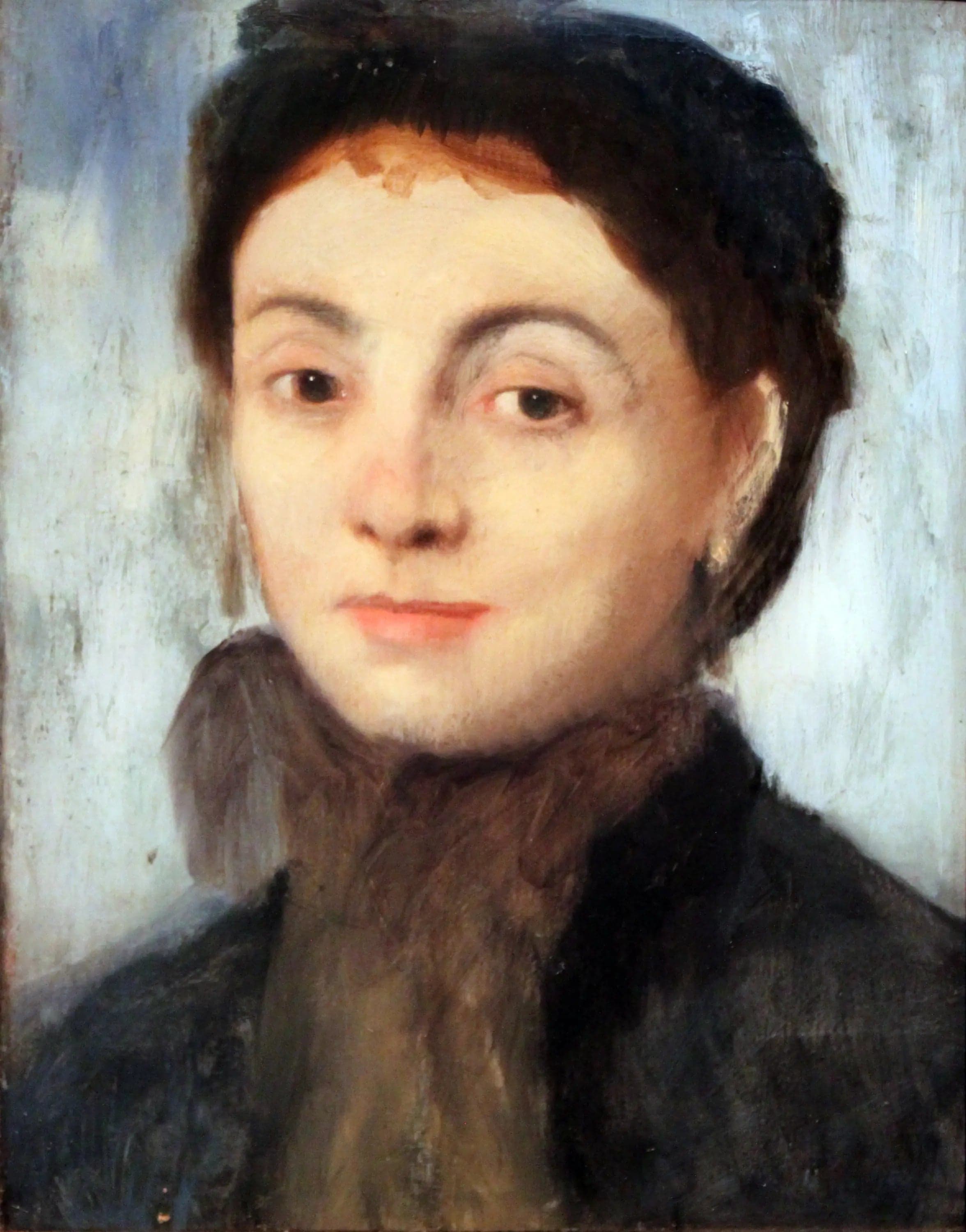
Portrait of Joséphine Gaujelin
- Original dimensions
- 27 x 35 cm
- Museum
- Hamburg Kunsthalle
- Year
- 1867
Scene depicted
The painting “Portrait of Joséphine Gaujelin” depicts a young woman of unparalleled grace, the artist managing to capture the intimacy of her gaze and the delicacy of her features. Degas uses plays of light to convey the personality and inner life of his model, making this pictorial work much more than just a simple portrait: it is a dive into the human psyche.
Historical context
Created in 1867, in the heart of Paris, this painting is emblematic of the Impressionist movement that was redefining artistic conventions. The painting is now exhibited at the Hamburg Kunsthalle , a true treasure of artistic history, measuring 27 by 35 cm.
Place in the artist's career
This painting fits into a flourishing period for Degas, marked by the exploration of human forms and fleeting moments. Alongside works such as “The Dance Class” and “The Dancers,” the “Portrait of Joséphine Gaujelin” highlights the technical evolution of the artist, moving from a classical style to an intimate exploration of feelings.
Anecdote
“I have always thought that light was the soul of a painting.” Thus spoke Degas, inspired one spring morning by the mysterious gaze of Joséphine Gaujelin in a quiet alley. This fleeting encounter gave birth to a masterpiece , filled with sweetness and subtlety, capturing a rare human essence.