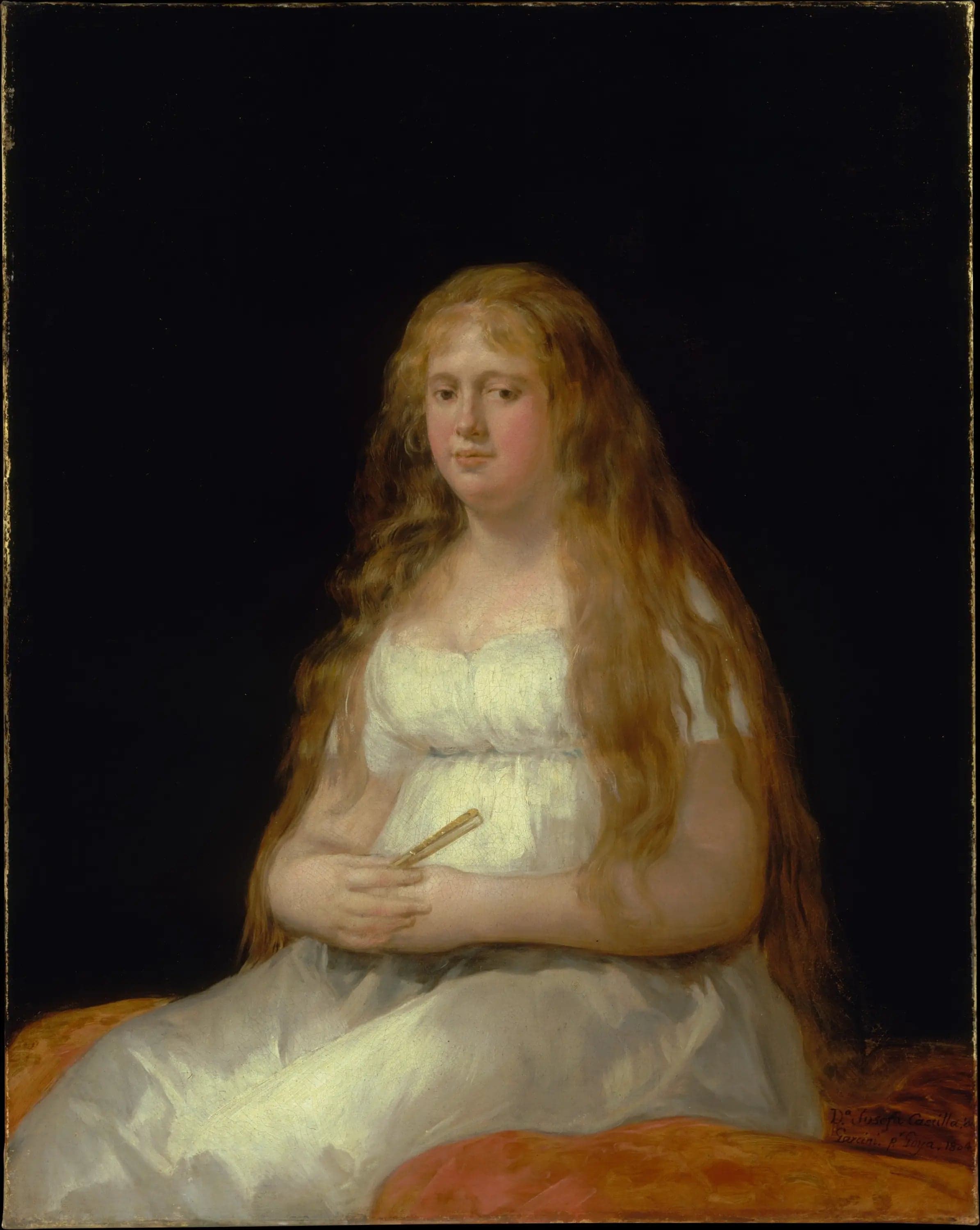
Portrait of Josefa de Castilla Portugal and van Asbrock de Garcini
- Original dimensions
- 82.2 x 104.1 cm
- Museum
- Gallery 619, Goya and Eighteenth-Century Italy, Metropolitan Museum of Art
- Year
- 1804
Scene depicted
The canvas “Portrait of Josefa de Castilla Portugal and van Asbrock de Garcini” presents a majestic female figure, enhanced by luxurious drapery, reflecting her social status, but also the emotional subtleties of her character. Josefa, with her enigmatic gaze, seems to whisper secrets of the past, offering a silent dialogue between her and the viewer.
Historical context
Created in the heart of Madrid, this painting embodies an iconic piece born in a Spain influenced by neoclassical and romantic currents. The canvas echoes a time when art became a means of expressing feelings and inner truths. Currently, it proudly adorns the walls of the Museum mentioned, captivating visitors with its impressive dimensions.
Place in the artist's career
This masterpiece is part of Goya's mature period, a testament to his ability to merge reality and feeling. By comparing “Las Meninas” by Velázquez and “The Omrani Charges” by Goya, one observes a spectacular evolution towards unprecedented emotional intimacy, here embodied by the canvas .
Anecdote
“Art is the mirror of the soul,” said Goya. This quote resonates when discussing the genesis of his masterpiece . As a gentle spring light filtered through the windows of his studio, the artist locked eyes with Josefa, a muse embodying the secret beauty of her time. This fleeting moment then becomes the very essence of the painting .