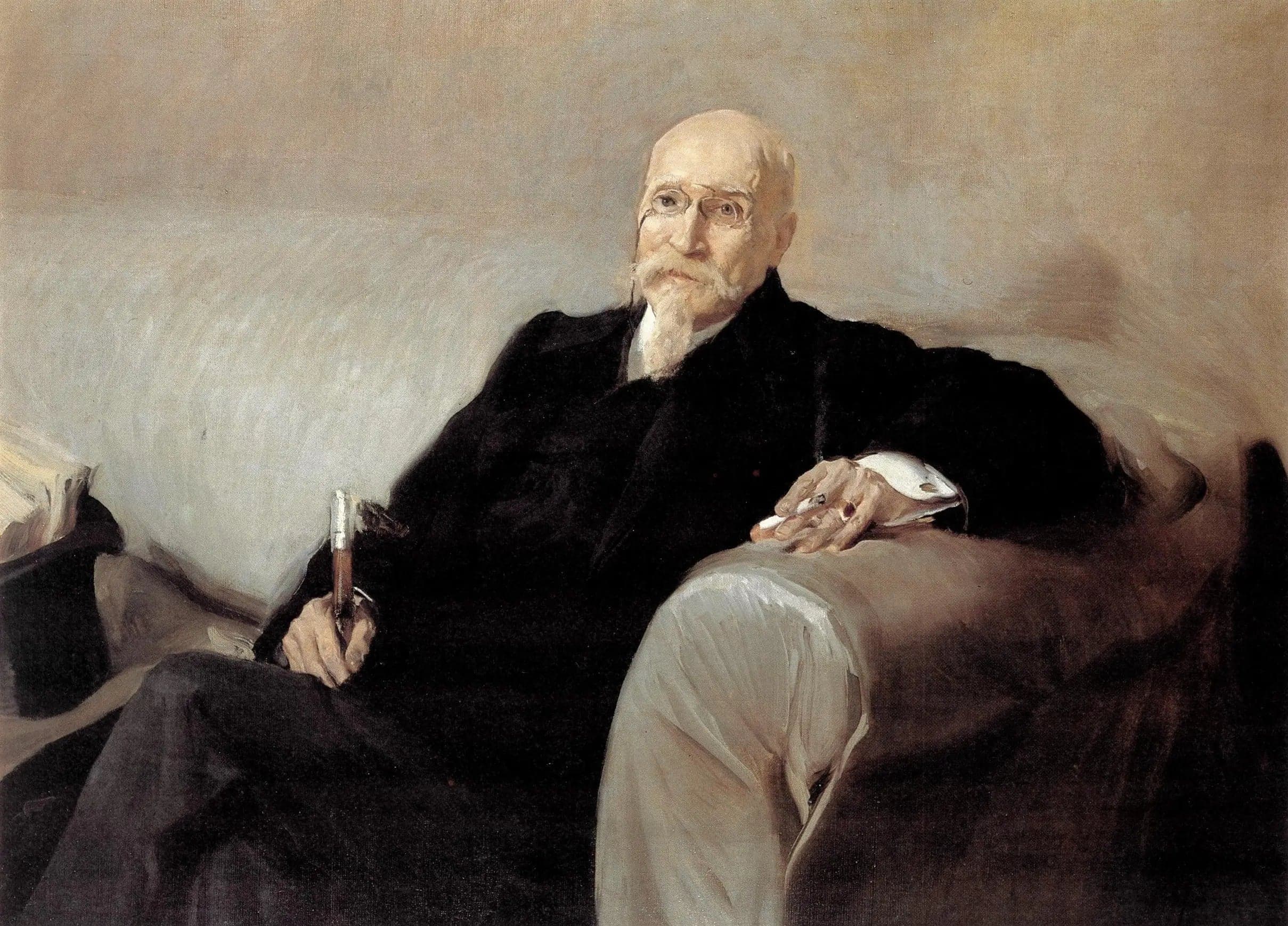
Portrait of José Echegaray
- Original dimensions
- 134 x 99 cm
- Museum
- Not specified
- Year
- 1905
Scene depicted
The painting “Portrait of José Echegaray” reveals a moment of serenity and concentration. The character stands confidently, his posture reflecting dignity while hinting at vulnerability. It is a work that is both intimate and public, where light plays a key role, making it almost alive. The blurred background highlights the complex personality of this man, like a reflection of his journey. This painting is not limited to the outer appearance but dives into the very soul of its subject.
Historical context
Created in 1905, this painting is situated at the peak of the Spanish impressionist movement, which is then in full swing. Joaquín Sorolla , a virtuoso of light and color, managed to capture the essence of a prominent statesman and writer, José Echegaray, in a setting bathed in light. The canvas bears witness to the influences of the new Spanish art while fitting into a time of social and cultural changes. This masterpiece could reside in a private collection, an art gallery, or a museum, its fame attracting art enthusiasts from around the world.
Place in the artist's career
This masterpiece represents a crucial step in Sorolla's career, marking his transition from a promising young artist to a recognized master. At that time, he had already created iconic works such as “The Bordes de la Mer” and “La Sieste,” which testify to his skill in the play of light and shadows. With “Portrait of José Echegaray,” he refines his technique, integrating elements of realism into his impressionism , evoking both power and humanity.
Anecdote
“Light is my tool, and every face I paint has a story to tell.” These words from Sorolla resonate in every brushstroke of his painting . Imagine him, on a bright morning, strolling through the streets of Madrid, somewhere between the scent of freshly picked flowers and the whisper of the wind. It is this feeling of wonder that inspired the canvas and this aesthetic confrontation with the intimacy of his subject, Echegaray.