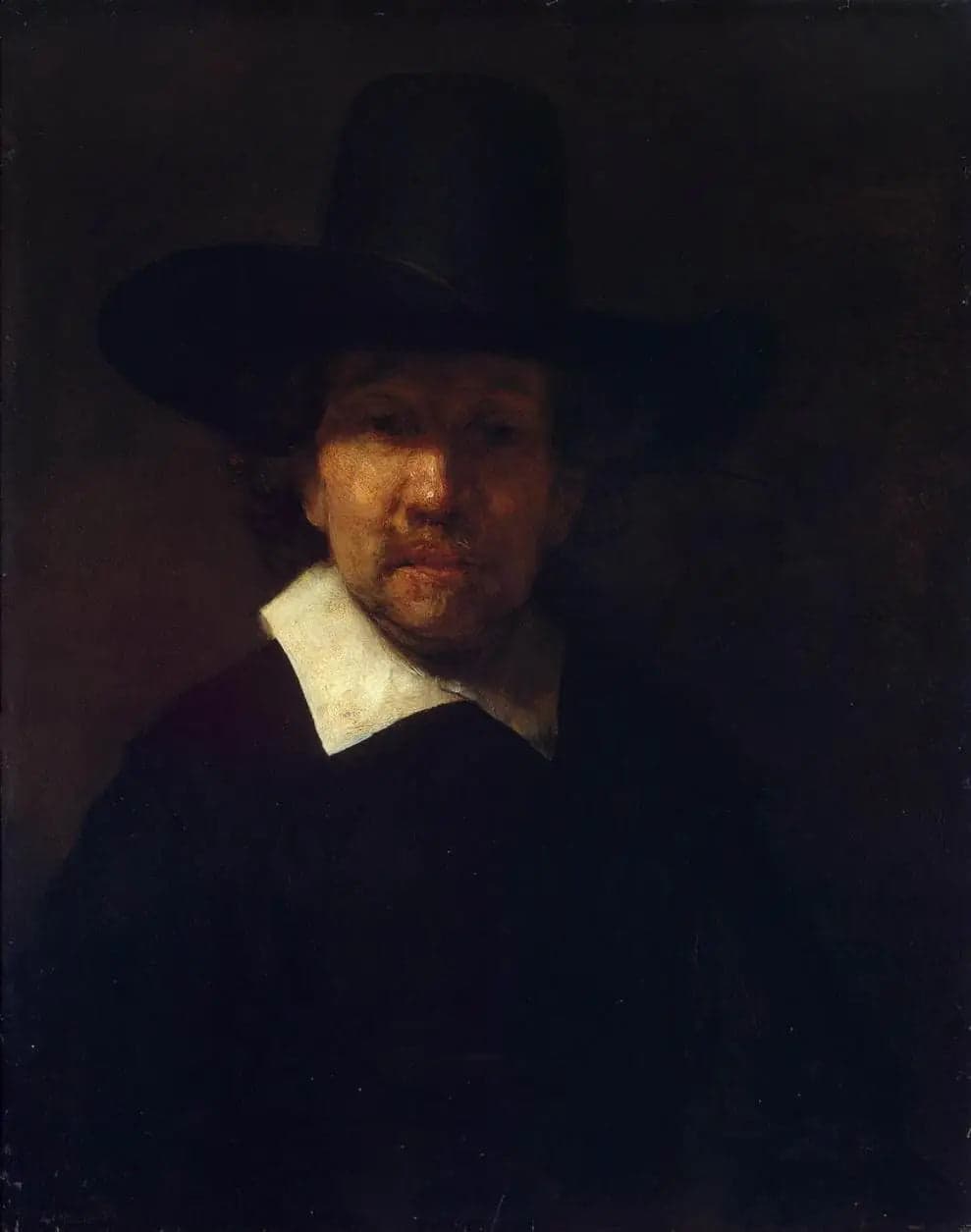
Portrait of Jérémie de Decker
- Original dimensions
- 56 x 71 cm
- Museum
- Hermitage Museum
- Year
- 1656
Scene depicted
In the canvas "Portrait of Jérémie de Decker," the viewer discovers the face imbued with wisdom and experience of a man at the turning point of his life. The master Rembrandt succeeds in capturing not only the physical features of Decker but also the entirety of his essence, surrounded by a reflective atmosphere, like a vintage echo that marries psychological depth with the sublime of painting.
Historical context
Created in 1656, in the vibrant workshops of Amsterdam, the painting "Portrait of Jérémie de Decker" is at the heart of the baroque movement, characterized by its rich emulsions of colors and contrasts of light. Today, this masterpiece is preserved in the prestigious Hermitage Museum , a showcase of the most beautiful pictorial works in history. The dimensions of this painting, 56 cm by 71 cm, make it an ideal composition to tell the intimate, while soaking in the magnificence of portraits of the time.
Place in the artist's career
This painting presents itself as a major turning point in the career of Rembrandt , revealing a stylistic peak of refined mastery. In parallel with other iconic works such as "The Night Watch" and "Self-Portrait with Two Circles," this composition places Rembrandt not only as a master of chiaroscuro but also as a pioneer of emotional expression through painting.
Anecdote
“Every face tells a story, and art is the means to make it resonate,” could have declared Rembrandt on a sunny morning, as the filtered rays caressed the canvas. Inspired by a glance exchanged in a peaceful alley of Amsterdam, he managed to immortalize in his work the humiliating depth and fleeting beauty of a human life, as illustrated in this vibrant portrait.