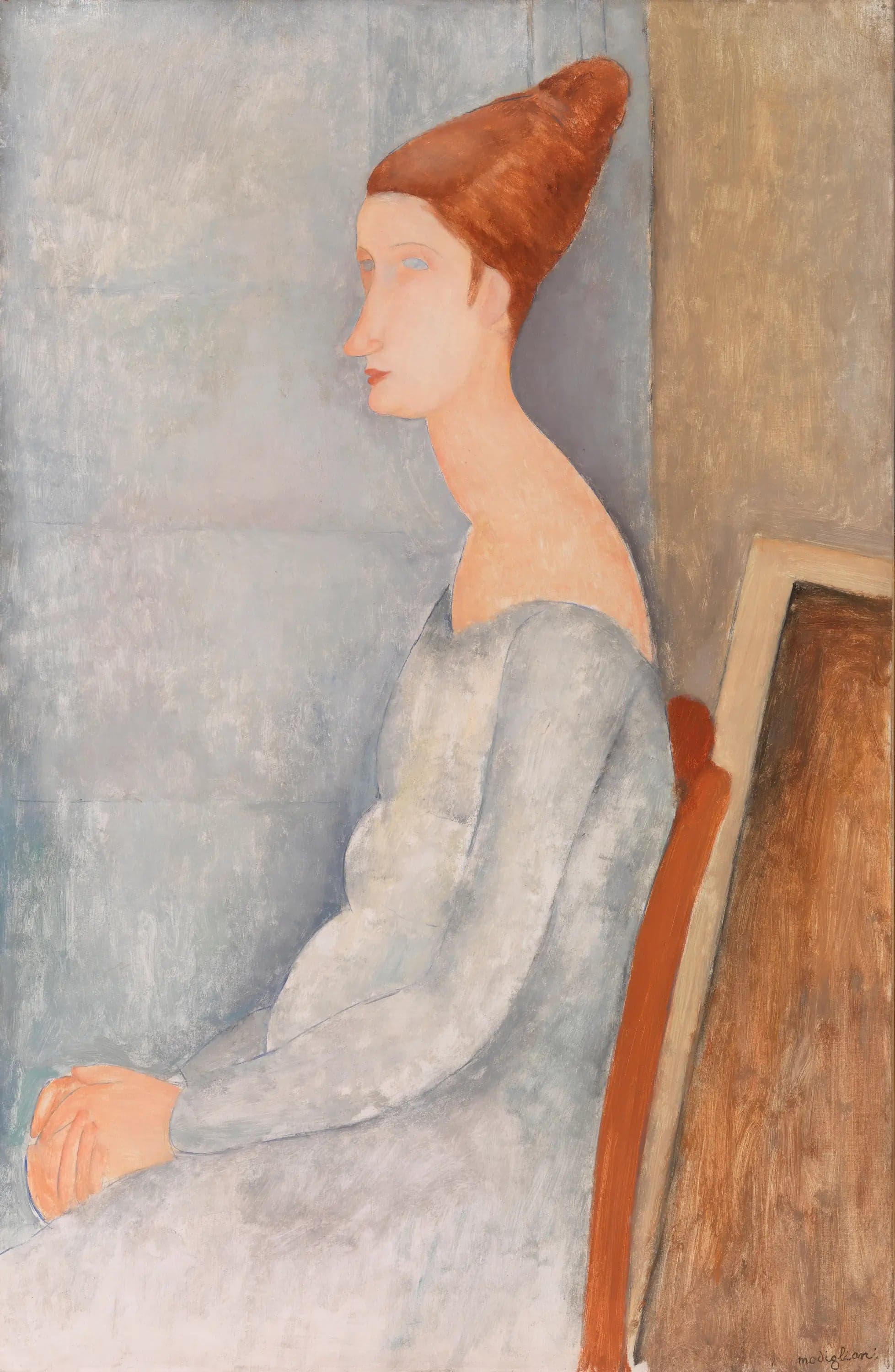
Portrait of Jeanne Hébuterne
- Original dimensions
- 64.8 x 99.7 cm
- Museum
- Barnes Foundation
- Year
- 1918
Scene depicted
In this emblematic composition , Jeanne Hébuterne is sublimated by her thoughtful gaze, her harmonious face, enveloped in an aura of mystery. The elongated lines and soft colors convey not only her beauty but also the depth of their relationship. The work does not merely represent; it invites the viewer to enter the inner universe of its subject, weaving a strong emotional bond.
Historical context
Created in 1918, the Portrait of Jeanne Hébuterne is set in the vibrant backdrop of Montparnasse in Paris, the true epicenter of the modern artistic movement of the early 20th century. Modigliani, with his unique style, managed to capture the essence of his time, blending Art Nouveau and expressionism in a breath of peace after the war. This prodigious canvas is currently housed at the Barnes Foundation , a sanctuary of art, revealing exceptional dimensions: 64.8 x 99.7 cm.
Place in the artist's career
This painting stands in Modigliani's career as a flagship work, illustrating the turning point of his stylistic expression. In the context of his work, it is close to the canvas of 1917, "Nu couché," and "Portrait of Chaim Soutine," revealing the evolutions of his technique and the poignant emotion he managed to introduce into his portraits.
Anecdote
Modigliani often said: "The beauty of a woman is not measured by her appearance, but by the soul she radiates.” His thoughts resonate in this masterpiece, created one spring morning, as he lingered over Jeanne, his muse and companion. The atmosphere of the moment, imbued with golden light and promises of the future, nourished the inspiration for this painting .