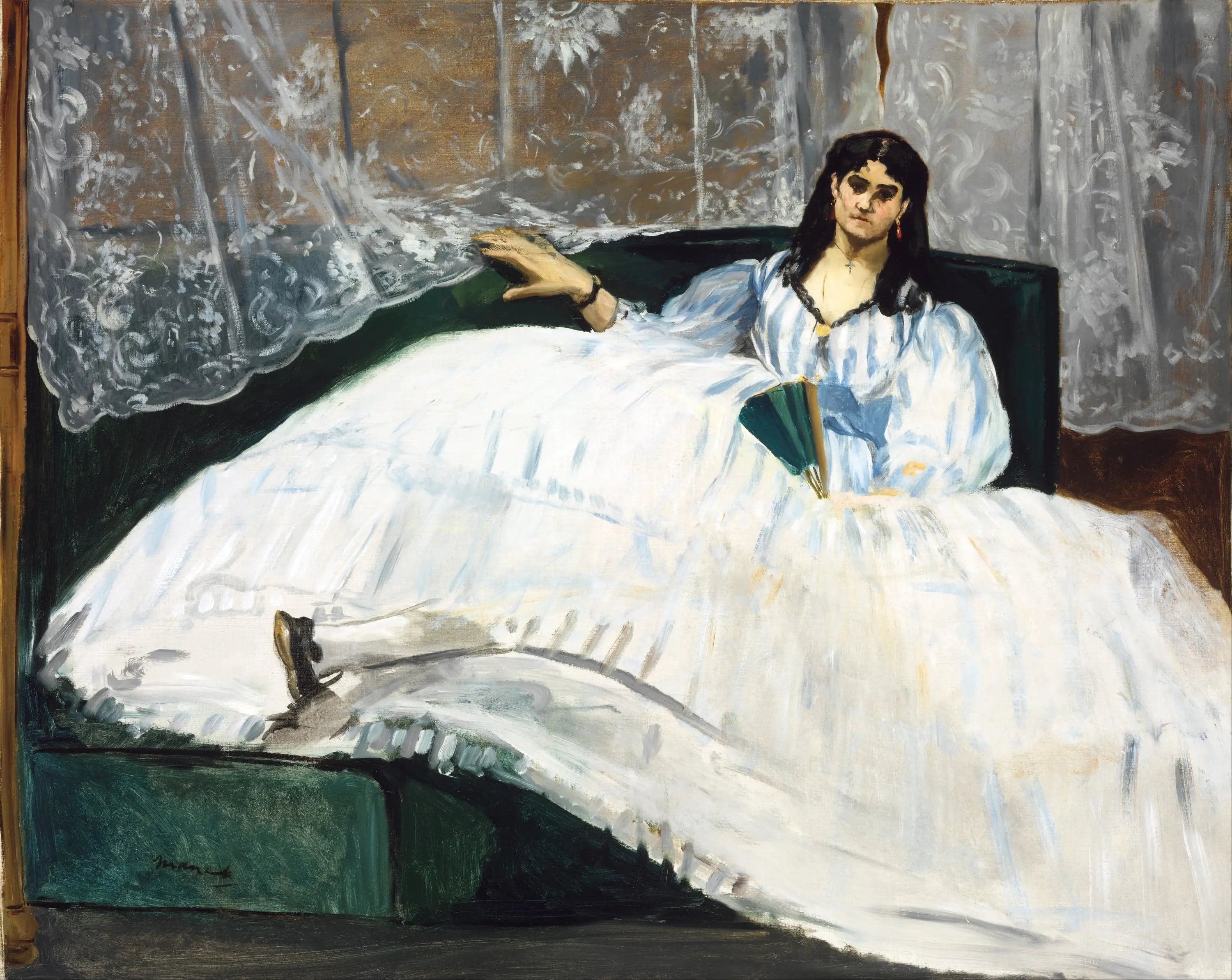
Portrait of Jeanne Duval
- Original dimensions
- 113 x 89.5 cm
- Museum
- Hungarian National Gallery
- Year
- 1862
Scene depicted
The painting Portrait of Jeanne Duval reveals a rich composition, where the elegance and sensuality of Jeanne, muse and companion of Manet, are delicately revealed. The canvas , capable of immortalizing this precious moment, immediately transports us into a universe where beauty and sophistication meet with a disturbing intensity.
Historical context
Created in 1862 in Paris, the heart of French artistic effervescence, the painting Portrait of Jeanne Duval is situated right in the middle of the Impressionist movement. At that time, Manet, an emblematic figure of modernity, distinguished himself by his bold choices and contemporary subjects. Currently, this painting is exhibited at the Hungarian National Gallery , inviting the visitor to discover the exceptional dimensions of the work, which express themselves powerfully through its 113 x 89.5 cm.
Place in the artist's career
This masterpiece marks a pivotal phase in Manet's career, revealing his artistic boldness. At that time, the artist begins to forge his distinct style, offering a striking contrast with works such as Le Déjeuner sur l’herbe and Olympia, where his technique and vision refine over time.
Anecdote
Manet once declared: “Every face tells a story.” Such were his words as he recalled the moment of a chance encounter, a beautiful light of a spring morning, when he crossed the gaze of Jeanne Duval. This painting then becomes the setting of a passion, merging the beauty of his model with the technical mastery of its creator.
Major exhibitions
The Black Model from Géricault to Matisse