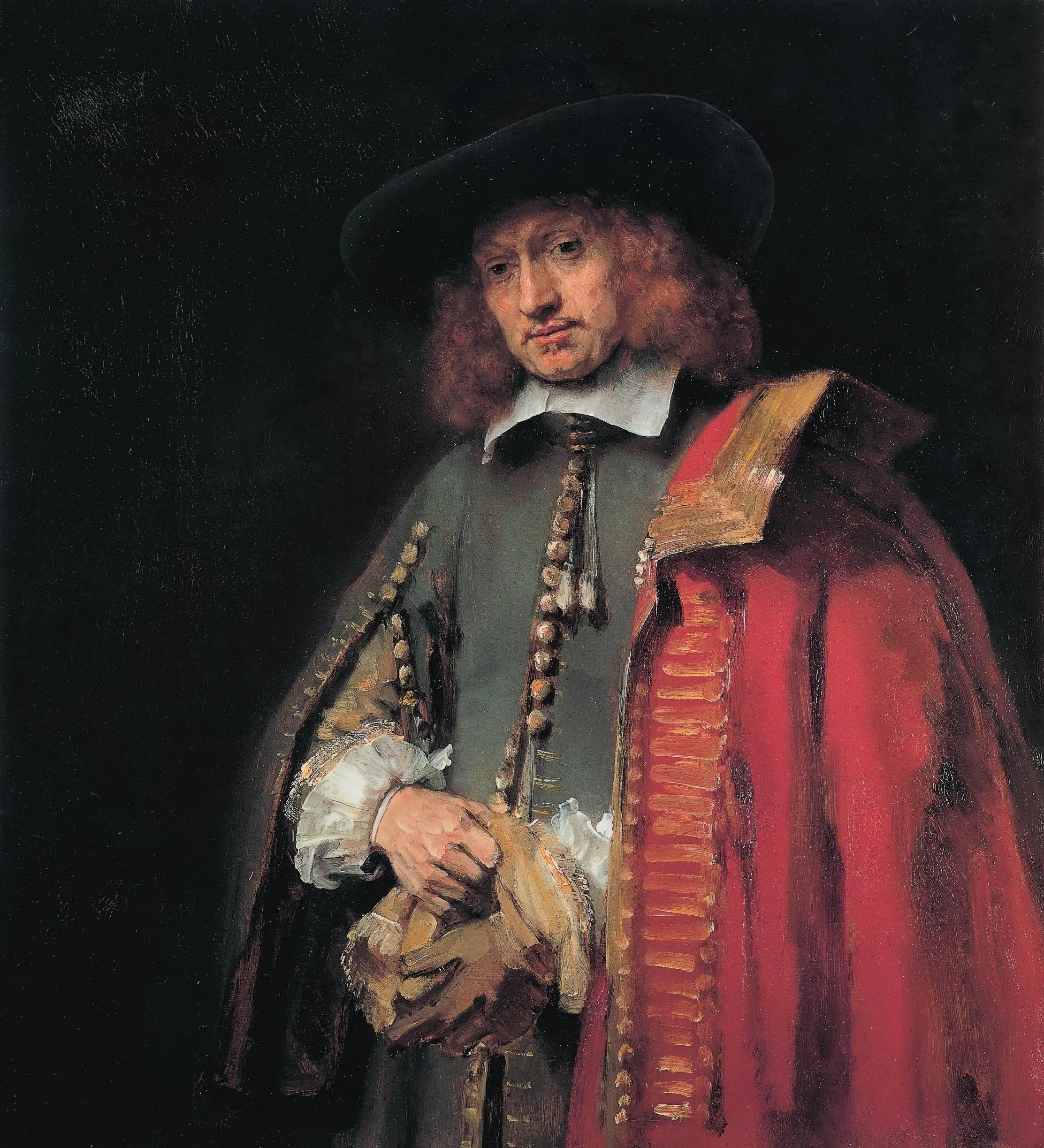
Portrait of Jan Six
- Original dimensions
- 102 x 112 cm
- Movement
- Dutch Golden Age of Painting
- Museum
- Amsterdam
- Year
- 1654
Scene depicted
This painting reveals a striking portrait of Jan Six, a notable figure of the time, who appears both observer and observed. The eyes, expressive and deep, invite the viewer to discover a silent story, while the rich fabric of his velvet garment and the finesse of the details evoke the grandeur of a man of refined stature. The nuances of light sculpt this painting, offering an unforgettable visual experience.
Historical context
Created in 1654, this remarkable painting stands at the heart of Amsterdam, a vibrant and bustling metropolis of the Dutch Golden Age of Painting. This masterpiece, still revered today, immerses us in a time when the richness and subtlety of light were explored with unmatched precision. The painting, currently displayed in a prestigious museum, testifies to the invaluable artistic legacy left by Rembrandt .
Place in the artist's career
Positioned at the heart of Rembrandt 's career, this painting represents the stylistic peak of his portraits, illustrating a turn towards greater intimacy and psychological depth. Works like “The Night Watch” and “The Anatomy Lesson of Dr. Tulp” mark this evolution, where light and shadow become the true protagonists of an emotional story.
Anecdote
“Every stroke of my brush is inspired by the soul of the subject,” Rembrandt might have said one spring morning in Amsterdam, as he sketched the features of Jan Six. It was in the simplicity of an enigmatic alley, bathed in soft lights where shadows danced, that he found the inspiration to capture the authenticity of this face, transforming a simple painting into a living work.