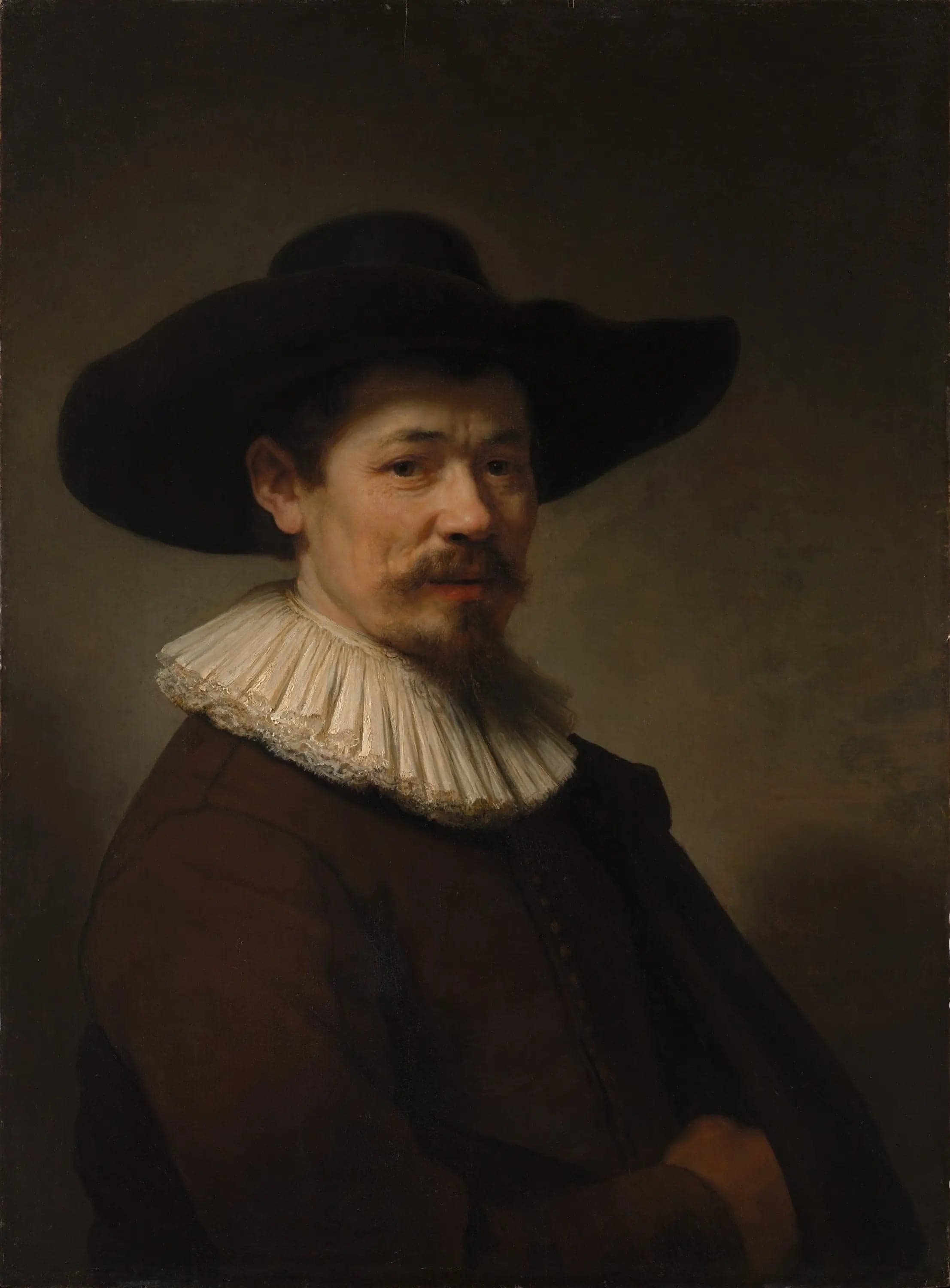
Portrait of Herman Doomer
- Original dimensions
- 55.2 x 75.2 cm
- Museum
- Metropolitan Museum of Art
- Year
- 1640
Scene depicted
The painting "Portrait of Herman Doomer" illustrates a moment of contemplation where the subject, dressed with care, seems to engage in a silent dialogue with the viewer. The subtle penetration of light accentuates Herman's facial features and offers a rare psychological depth, both for the artist and the character. Rembrandt does not merely reproduce appearances; he captures the soul and essence of his subject through the finesse of his brushstroke.
Historical context
Created in Amsterdam, this iconic painting bursts forth at the heart of a golden age, the 17th century, a time when the baroque movement illuminates art with its brilliance. In this vibrant and cosmopolitan city, Rembrandt , the undisputed master of light and shadow, captures the very essence of his time. The current painting is carefully preserved at the Metropolitan Museum of Art in New York, a prestigious setting for this masterful work measuring 55.2 x 75.2 cm.
Place in the artist's career
This painting represents a crucial step in Rembrandt's career. Situated in a period of great artistic maturity, it juxtaposes with other masterpieces such as "The Night Watch" and "The Girl of the Struck Man," thus revealing the evolution of his technical and emotional approach. The "Portrait of Herman Doomer" illustrates not only a mastery of light play but also a profound humanity that resonates through the ages.
Anecdote
Rembrandt is said to have once remarked: "Light is only seen through shadow." It was in the intimacy of a misty morning that our artist found inspiration, observing the face of Herman Doomer, a prominent member of the painters' guild. The soft light, filtered through a slightly crumpled curtain, offered a living tableau that begged to be immortalized on canvas.
Major exhibitions
One hundred masterpieces from Parisian collections