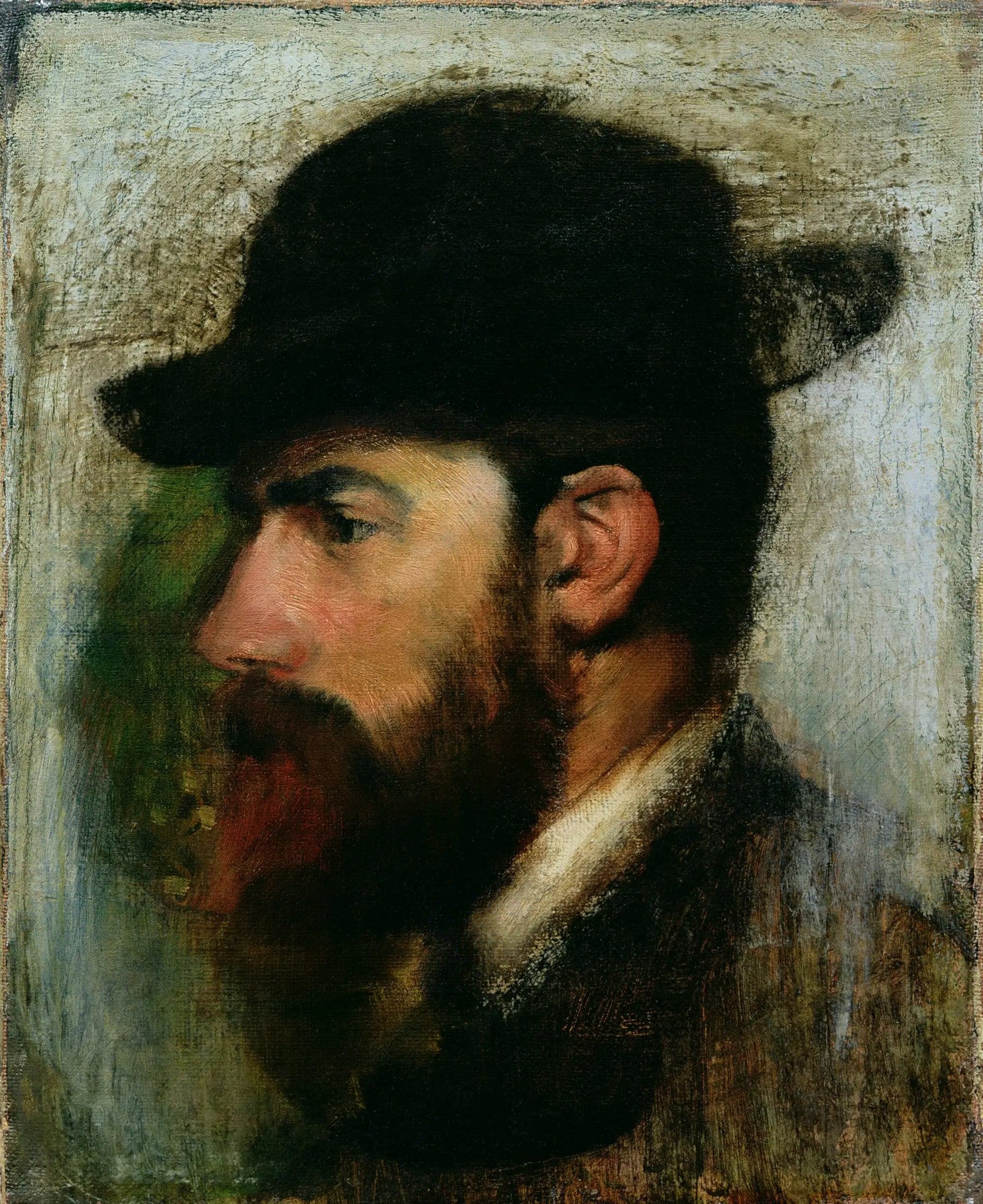
Portrait of Henri Rouart
- Original dimensions
- 22 x 27 cm
- Museum
- Marmottan Monet Museum
- Year
- 1871
Scene depicted
In this pictorial work, Degas captures the very essence of his subject, Henri Rouart, a friend and art collector. The painting reveals a thoughtful man, lost in his reflections, almost absorbed in an inner world. The composition is carefully balanced, Rouart's relaxed posture contrasting with the intensity of his gaze, thus creating a palpable connection between him and the observer.
Historical context
Created in 1871 in the vibrant Paris of the 19th century, this painting is at the heart of impressionism , an artistic movement that redefines the perception of light and movement through the canvas. Degas, an iconic figure of this era, delivers here a frozen moment, a snapshot of Parisian life. The painting is currently exhibited at the Marmottan Monet Museum in Paris, where it continues to captivate visitors with its finesse and elegance.
Place in the artist's career
The Portrait of Henri Rouart represents a turning point in Degas's career, fitting into a period of artistic maturity. Alongside his other iconic paintings like The Dancers and The Dance Class, one perceives a significant evolution in his technique and sensitivity. The representation of individuals in all their humanity becomes an obsession for Degas, and this masterpiece is a perfect illustration of that.
Anecdote
“Art is not what you see, but what you make others see.” This quote from Edgar Degas resonates deeply when contemplating the masterpiece that is the Portrait of Henri Rouart. Imagining Degas, immersed in his studio, one spring morning, inspired by the face of his friend, gives the painting an even stronger resonance, rooted in a sincere friendship and a benevolent gaze.