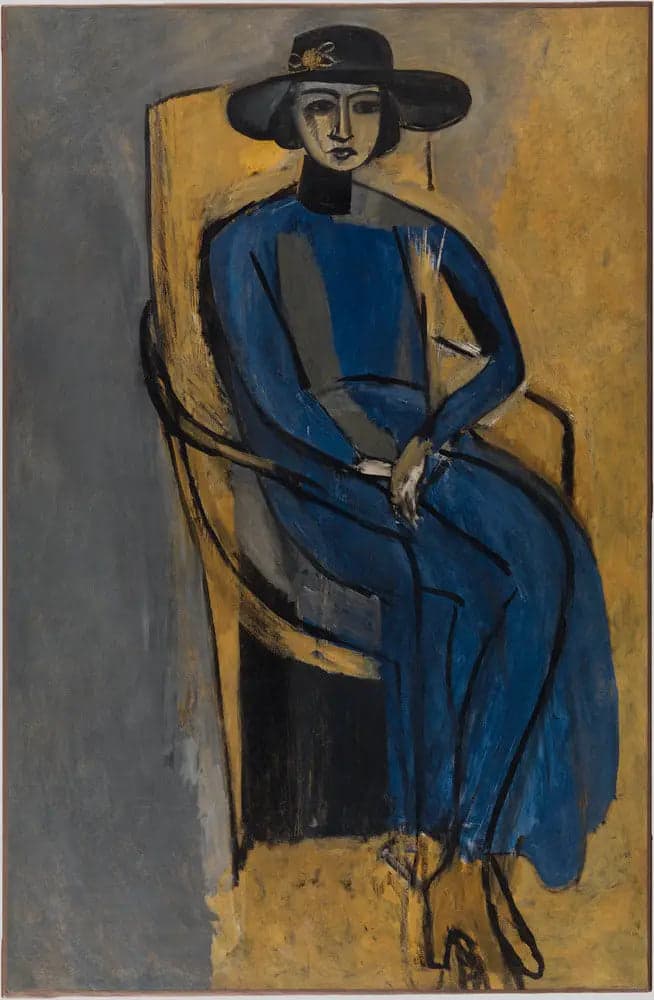
Portrait of Greta Prozor
- Original dimensions
- 96 x 146 cm
- Museum
- Centre national d'art et de culture Georges-Pompidou
- Year
- 1916
Scene depicted
The canvas “Portrait de Greta Prozor” highlights the serenity and depth of a face, illuminated by vibrant and bold colors, revealing the intimate character of the protagonist. Matisse presents a scene of striking modernity, abstracting from traditional norms to make way for pure emotion and refined gesture. This pictorial work, bathed in light, transcends the simple portrait to become a unique sensory experience.
Historical context
Created during the year 1916, this painting is set against the tumultuous backdrop of World War I. Its author, Henri Matisse , is one of the emblematic figures of Fauvism , a movement that celebrates color and personal expression. The canvas is currently housed in the prestigious Centre national d'art et de culture Georges-Pompidou in Paris, where it resonates with the legacy of a creative and dynamic artistic era.
Place in the artist's career
This painting is positioned at a crucial period in Matisse's career, marking a stylistic peak where the artist emancipates himself from conventions. Alongside works like “La Danse” and “Le Bonheur de Vivre,” “Portrait de Greta Prozor” testifies to an evolution towards a more free and expressive artistic language, thus consolidating his status as an undisputed master of Fauvism .
Anecdote
“Color is the key to reality,” said Matisse, thus evoking the very essence of his masterpiece . He is said to have conceived this work during a sunny morning in his Paris studio, inspired by the transformative beauty of his model, Greta Prozor. This emotion of wonder is embedded in the visual strength of the painting , capturing a fleeting yet eternal essence.