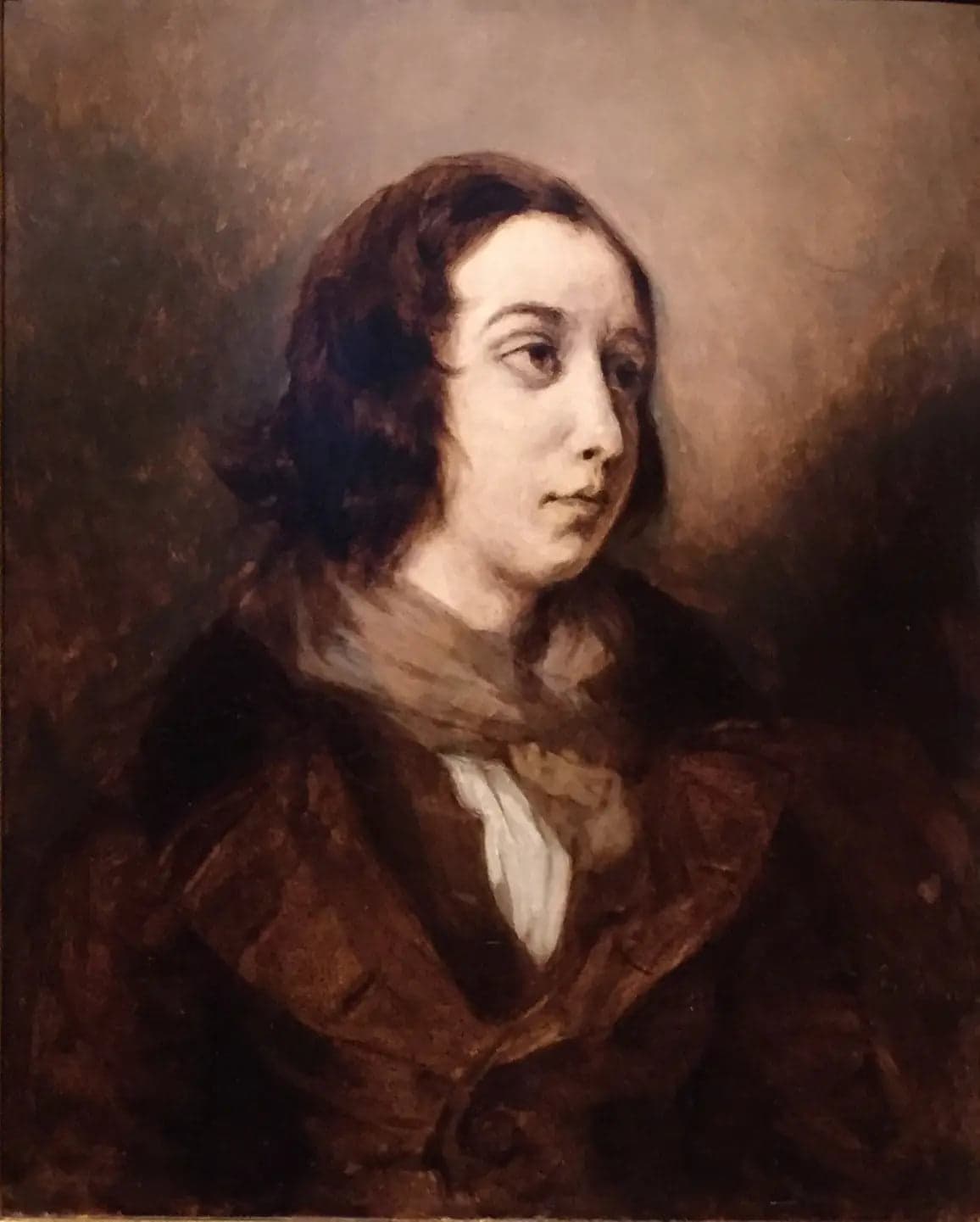
Portrait of George Sand
- Original dimensions
- 21.3 x 26 cm
- Movement
- romanticism
- Museum
- national museum Eugène-Delacroix
- Year
- 1834
Scene depicted
In this painting , Delacroix pays tribute to the writer George Sand through a composition where the delicacy of her face contrasts with the strength of her character. The soft light highlights her features, evoking not only her beauty but also her free and intellectual spirit. Each brushstroke tells a story, immersing us in her creative universe.
Historical context
Created in 1834, at the heart of the romantic movement, the painting "Portrait of George Sand" still resonates in the streets of Paris. This iconic canvas , displayed at the national museum Eugène-Delacroix, captures the essence of a time when emotions and passions took precedence over classical rigor. Its dimensions of 21.3 x 26 cm reveal an astonishing intimacy, showcasing a pioneer of modern portraiture in a rich and flourishing cultural context.
Place in the artist's career
"Portrait of George Sand" marks a crucial turning point in Delacroix's career, this painting symbolizing a bold fusion between romanticism and portraiture. Alongside canvases such as " Liberty Leading the People " and "The Combat of the Amazons," one perceives his evolution from a heroic style to a more personal and emotional introspection, bearing the mark of a true innovator.
Anecdote
"Inspiration is often found where one least expects it," said Delacroix, recalling that spring morning when he met George Sand's gaze. Their sincere exchanges in a Parisian café were the catalyst for this pictorial work that transcends the simple portrait to capture the vibrant soul of a revolutionary artist.