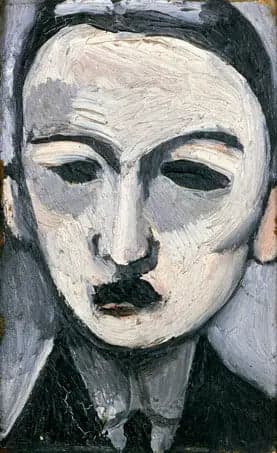
Portrait of George Besson
- Original dimensions
- 8 x 14 cm
- Museum
- Museum of Fine Arts and Archaeology of Besançon
- Year
- 1918
Scene depicted
The painting "Portrait of George Besson" illustrates with rare poetry the spirit of fauvism , through a vibrant play of cheerful colors and bold shapes. Matisse, as a captor of emotions, manages to immortalize not only the features of his friend, art collector George Besson, but also a sensory experience, making the viewer a witness to a moment suspended between the real and the imaginary.
Historical context
Created in 1918, during a time marked by fauvism , the painting Portrait of George Besson embodies the dynamic interaction of colors and emotions characteristic of this artistic movement. It is in Besançon, a city rich in cultural history, that this work stands out today within the Museum of Fine Arts and Archaeology. With delicate dimensions of 8 x 14 cm, this painting invites us to dive into the intimacy of a portrait that transcends time.
Place in the artist's career
This painting , marking a significant milestone in Matisse's career, sits at the crossroads between his fauvist period and his later explorations. Alongside other works like "The Dance" and "The Joy of Life," we can observe an emotional and technical evolution that enriches the artist's scope and his bold approach to painting .
Anecdote
Henri Matisse once whispered: “Color is my way of speaking, my breath of life.” It is this inspiring feeling that seized him as he painted in the shadow of a sunny morning at the Hotel Beau-Rivage. This fleeting moment, this face encountered, infused a vibrant strength into the painting , giving it a unique depth of soul, made visible through each brushstroke of the masterpiece .