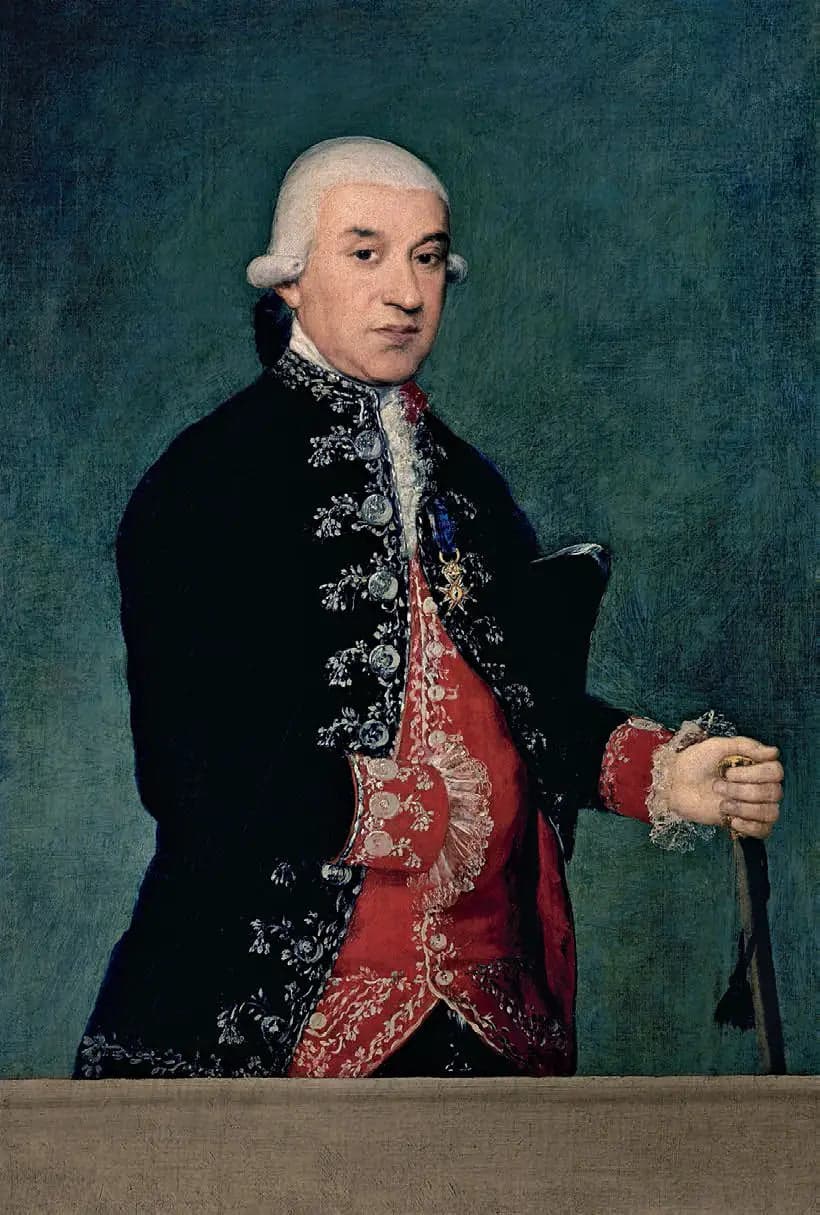
Portrait of Francisco Javier de Larrumbe
- Original dimensions
- 77 x 113 cm
- Museum
- Bank of Spain (Madrid)
- Year
- 1787
Scene depicted
The painting depicts Francisco Javier de Larrumbe, a charismatic nobleman, dressed in a luxurious frock coat. Goya captivates with the detail refining every feature, every shadow that inhabits the model's face. Contemplating this pictorial work, one feels a palpable tension, a vibrant relationship between the subject and the artist, leaving the viewer moved by the depth of this composition.
Historical context
This painting emblematic, completed in 1787, flourishes in the vibrant city of Madrid, at the heart of Spain and its cultural upheavals. At that time, Goya, a prominent figure of the romantic movement, gradually established himself as the official painter of the court, navigating between classics and modernity. His artistic legacy is rooted in a period of effervescence, where the shadow of the inquisition fades in the face of rays of new ideas. The painting is currently housed at the Bank of Spain, like a jewel in a case, preserved for future generations.
Place in the artist's career
This masterpiece constitutes a key milestone in Goya's career, marking a turning point towards artistic maturity. Compared to works such as “The Maja” and “The Family of Charles IV”, this painting illustrates his evolution, oscillating between striking realism and romantic idealization, while capturing the complexity of the world around him.
Anecdote
“A canvas is the soul of a moment frozen” could have said Goya, evoking the creation of his masterpiece . In a Madrid street, the sweet scent of spring flowers mingled with the discreet murmur of passersby. It was there, in a sunny square, that Goya captured the depth of Larrumbe's gaze, transforming this fleeting moment into an eternal painting .