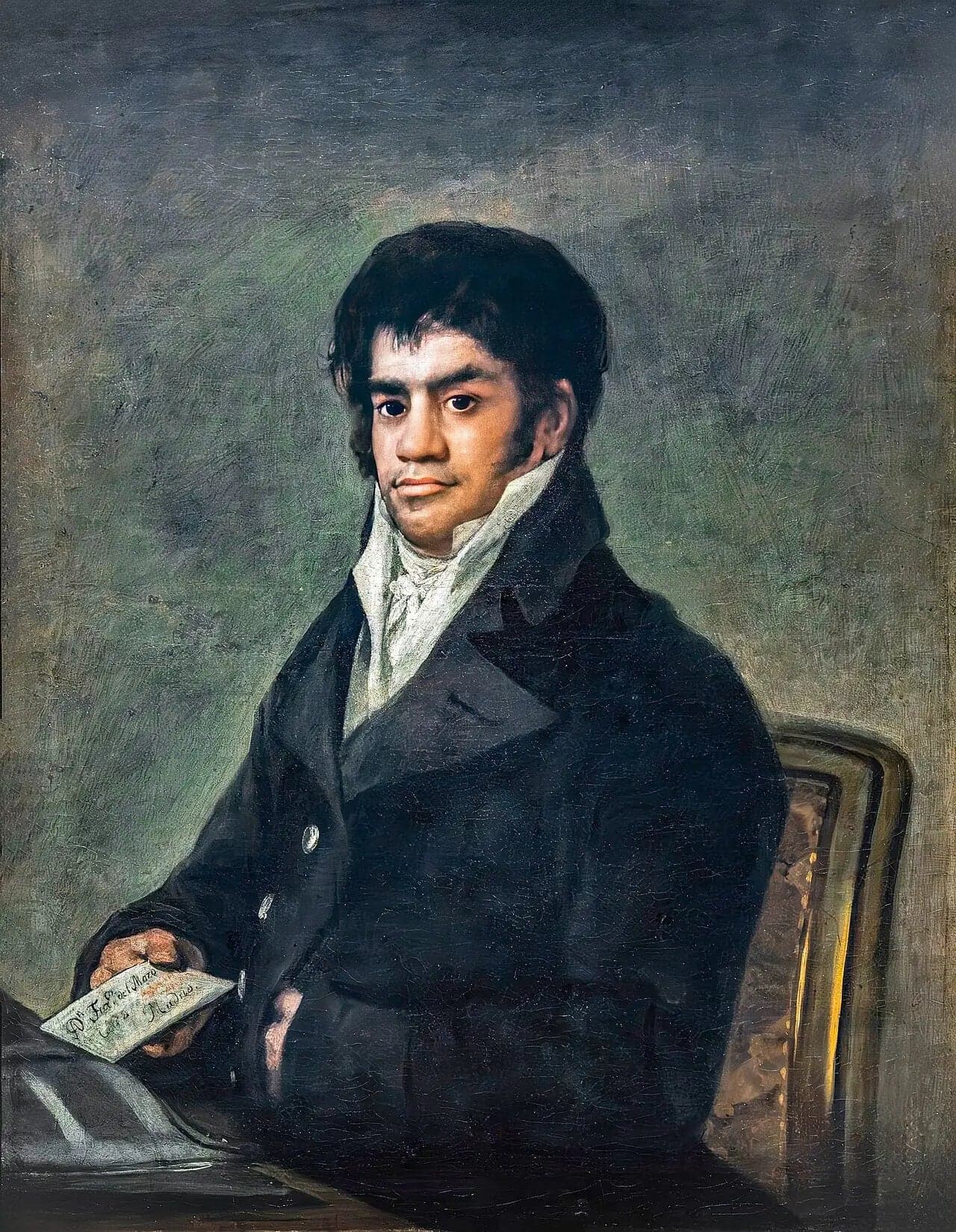
Portrait of Francisco del Mazo
- Original dimensions
- 71 x 90.5 cm
- Movement
- romanticism
- Museum
- Goya Museum
- Year
- 1817
Scene depicted
In this painting, Goya meticulously depicts the portrait of Francisco del Mazo, a man with an intense gaze and eloquent posture. The artist captures the very essence of his subject, illuminating his features with a soft and natural light that seems to breathe life. The composition highlights a subtly nuanced palette, bathing the scene in an atmosphere that is both intimate and poignant.
Historical context
Created in 1817, the painting Portrait of Francisco del Mazo is part of the romantic movement, a period marked by strong emotional expression and a quest for authenticity. This pictorial work finds its origin in Madrid, the capital of Spanish culture, and unfolds in a context where Goya, already famous, explores the nuances and complexities of the human condition. Today, this painting is preserved in the Goya Museum, a sanctuary of art where each canvas tells a story, accentuated by its imposing dimensions of 71 x 90.5 cm.
Place in the artist's career
Portrait of Francisco del Mazo is a masterpiece in Goya's career, marking a period of artistic maturity. It is situated between other iconic works such as The Maids of Honor and The Colossus , where raw realism and psychological introspection juxtapose. This painting illustrates Goya's technical evolution towards an ever more palpable emotional depth, as he boldly perfects his style.
Anecdote
Goya, known for his intimate reflections and penetrating portraits, once said: “Every face is a story, a reflection of the soul.” It was thus that he drew his inspiration one April morning, as he observed Francisco del Mazo, a man whose features were marked by life. This fleeting encounter between their gazes was the origin of the evocative power of the masterpiece that is Portrait of Francisco del Mazo .