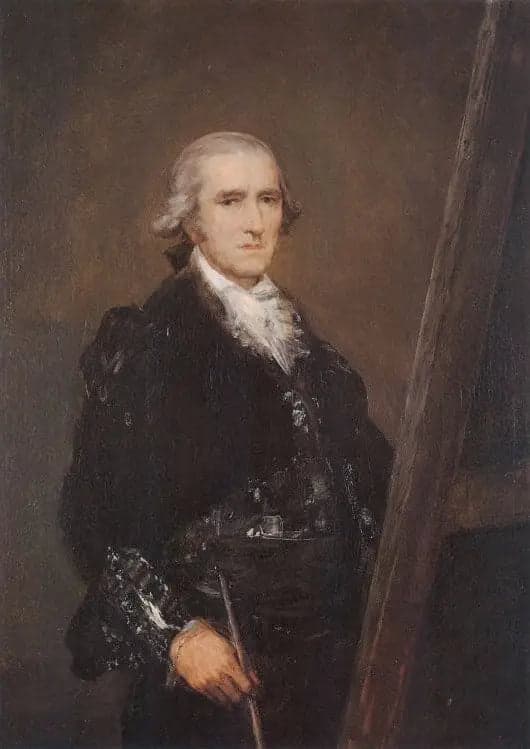
Portrait of Francisco Bayeu
- Original dimensions
- 84.5 x 112.5 cm
- Museum
- Museum of Fine Arts of Valencia
- Year
- 1786
Scene depicted
This painting finely represents Francisco Bayeu, an influential painter and collaborator of Goya. The work depicts Bayeu with a thoughtful gaze, a hand delicately placed on the table, symbolizing intellect and creativity. The neutral background highlights the imposing stature of the artist, evoking his importance in the artistic world of the time.
Historical context
Created in 1786 in Valencia, this painting is part of the current of Spanish Romanticism . At that time, the vibrant city was a cultural crossroads, where art and science mingled under the influence of Enlightenment. Goya, then on the rise, sought to capture the essence of his contemporaries, making this canvas not only historical but also deeply human.
Place in the artist's career
This painting marks a turning point in Goya's career, illustrating his transition from an academic style to a more personal and expressive approach. It juxtaposes with works such as “La Maja Desnuda” and “The Executions of May 3,” where the artist reveals his growing mastery of human emotions, a common thread in his career.
Anecdote
“A canvas does not just capture a face, it immortalizes a soul,” Goya might have said while contemplating the splendid portrait of Bayeu. The inspiration may have come to him one spring morning, around a quiet alley, where the sweet scent of flowers mingled with the whispers of artisans. This pictorial work displays a palpable emotion, breathing the delicacy of daylight.