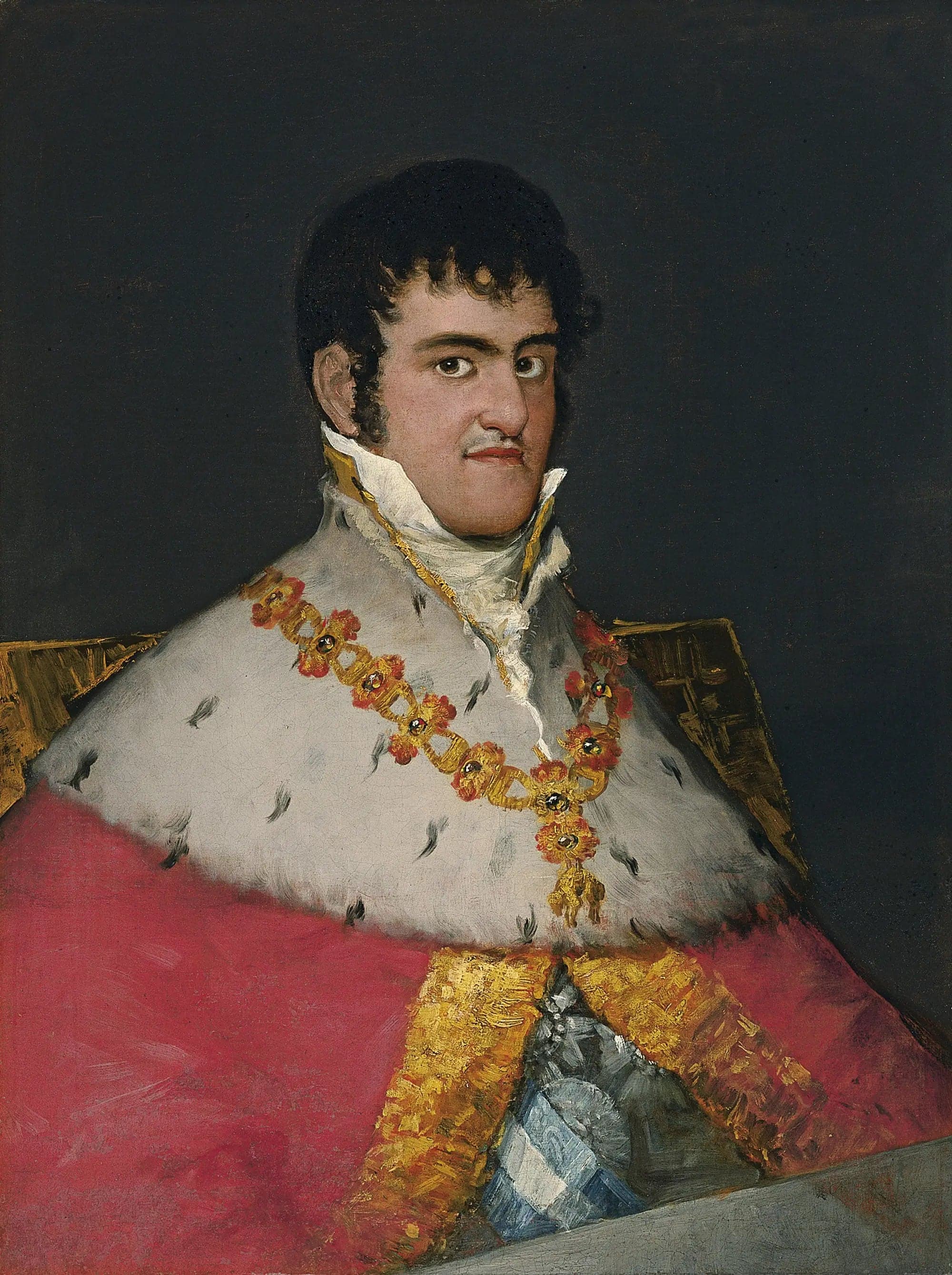
Portrait of Ferdinand VII
- Original dimensions
- 63.5 x 84 cm
- Museum
- Thyssen-Bornemisza Museum
- Year
- 1814
Scene depicted
This painting emblematic presents Ferdinand VII, the King of Spain, dressed with magnificence and authority. Goya chooses to show him in all his stature, the pose reflecting both the grandeur and the fragility of a reign shaken by internal struggles. The dark background accentuates Ferdinand's royal appearance, revealing the underlying tensions of his reign. This moment frozen in time is much more than a simple portrait; it is a reflection on power, responsibility, and the turmoil of the Spanish monarchy.
Historical context
Created in 1814, in the heart of Madrid, Spain, this painting illustrates not only a sovereign but also a troubled era marked by the conflicts of the Spanish War of Independence. Francisco de Goya , a leading figure of romanticism and a precursor of modernism, managed to capture the very essence of his time through this canvas . Currently, the painting , a true national treasure, is displayed at the Thyssen-Bornemisza Museum, offering visitors a window into a tumultuous past.
Place in the artist's career
“Portrait de Ferdinand VII” is situated at a turning point in Goya's career, marking a period of maturity and stylistic experimentation. This painting is part of a series of royal portraits, where Goya deploys his talent to capture the humanity behind the status. In contrast, his work "The Executions of May 3rd" shows another facet of his commitment, translating the sufferings of his time. Thus, a palpable evolution can be observed between these two paintings , where the treatment of the subject and the pictorial technique reveal an increasing emotional depth.
Anecdote
“Every brushstroke reveals a piece of the human soul,” Goya said while contemplating his own creations. This resonates particularly when looking at the golden halo of his masterpiece , where inspiration came to him one spring morning, when the sunlight played on the face of a nobleman. The emotions captured in this moment imbue the painting with exceptional depth, inviting each observer to immerse themselves in the intimacy of this canvas .