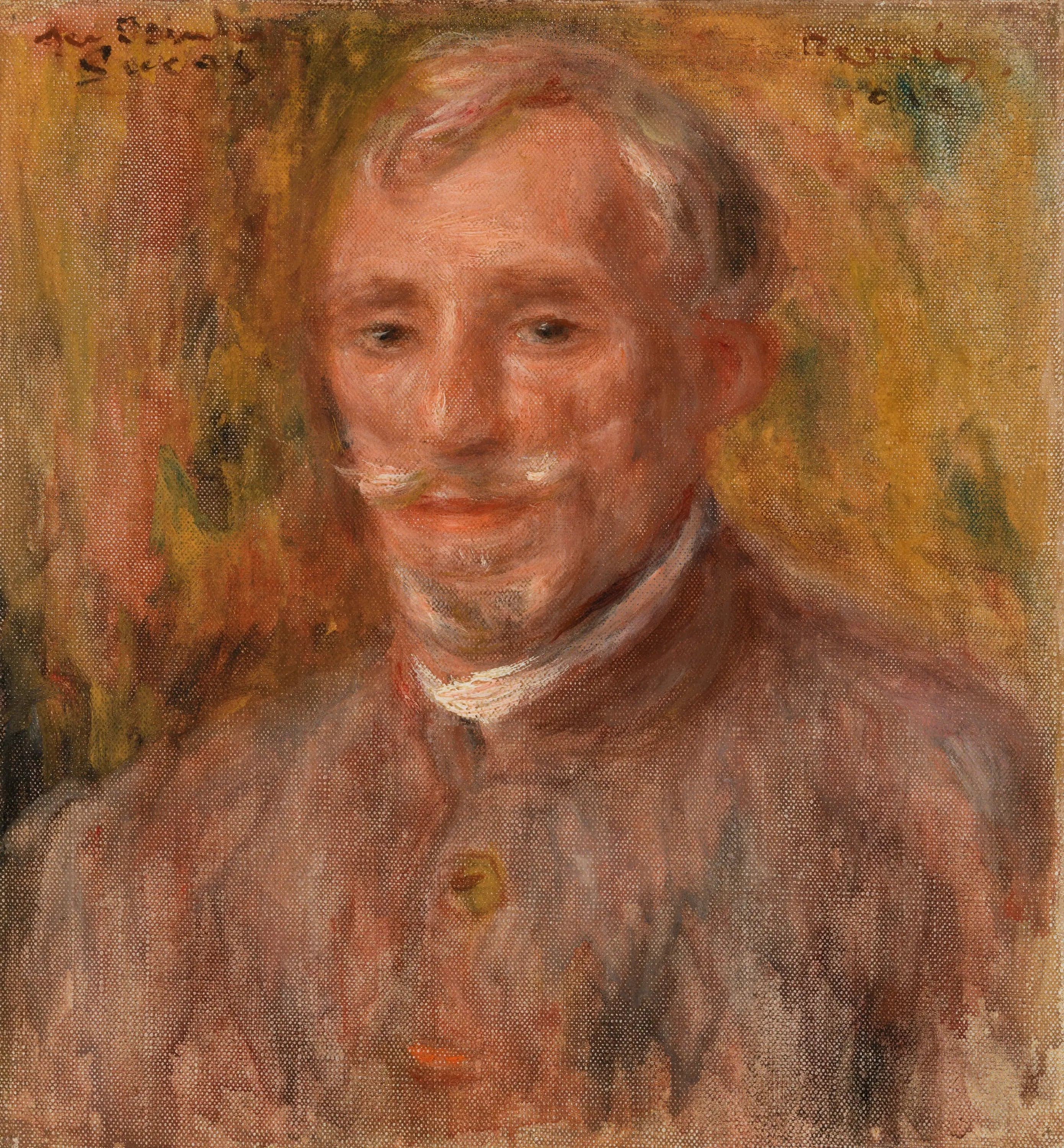
Portrait of Félix Hippolyte-Lucas - Pierre
- Original dimensions
- 29.5 x 31.5 cm
- Museum
- Barnes Foundation
- Year
- 1918
Scene depicted
This painting reveals an intimate and touching portrait of Félix Hippolyte-Lucas, highlighting his personality through plays of light and shadow. Renoir evokes not only a face but also a profound humanity, each narrative brushstroke allowing the very essence of his subject to shine through. A vibrant scene where the artist combines technique with emotion, perfectly illustrating the richness of Impressionism .
Historical context
Created in 1918, at the end of a period rich in artistic upheavals, the painting "Portrait de Félix Hippolyte-Lucas" is the result of the reflections of Auguste Renoir , a master of the Impressionist movement, who was able to capture human essence with striking emotional depth. This canvas is currently preserved at the Barnes Foundation in Philadelphia, a temple dedicated to art where it interacts with other masterpieces of modern art.
Place in the artist's career
Situated at a turning point in his career, where artistic maturity is at its peak, "Portrait de Félix Hippolyte-Lucas" represents a culmination of his aesthetic explorations. Alongside "Les Baigneuses" and "L’Embarquement pour Cythère", this painting bears witness to the remarkable evolution of Renoir's style, moving from a purity of form to an intense emotional exploration, increasingly incisive.
Anecdote
Renoir once confided: "I want to show the soul of people, their light, their warmth." It is in a spring softness, through a gentle glow of light, that he captured the face of Félix Hippolyte-Lucas, thus magnifying a fleeting encounter into a pictorial work of timeless beauty.