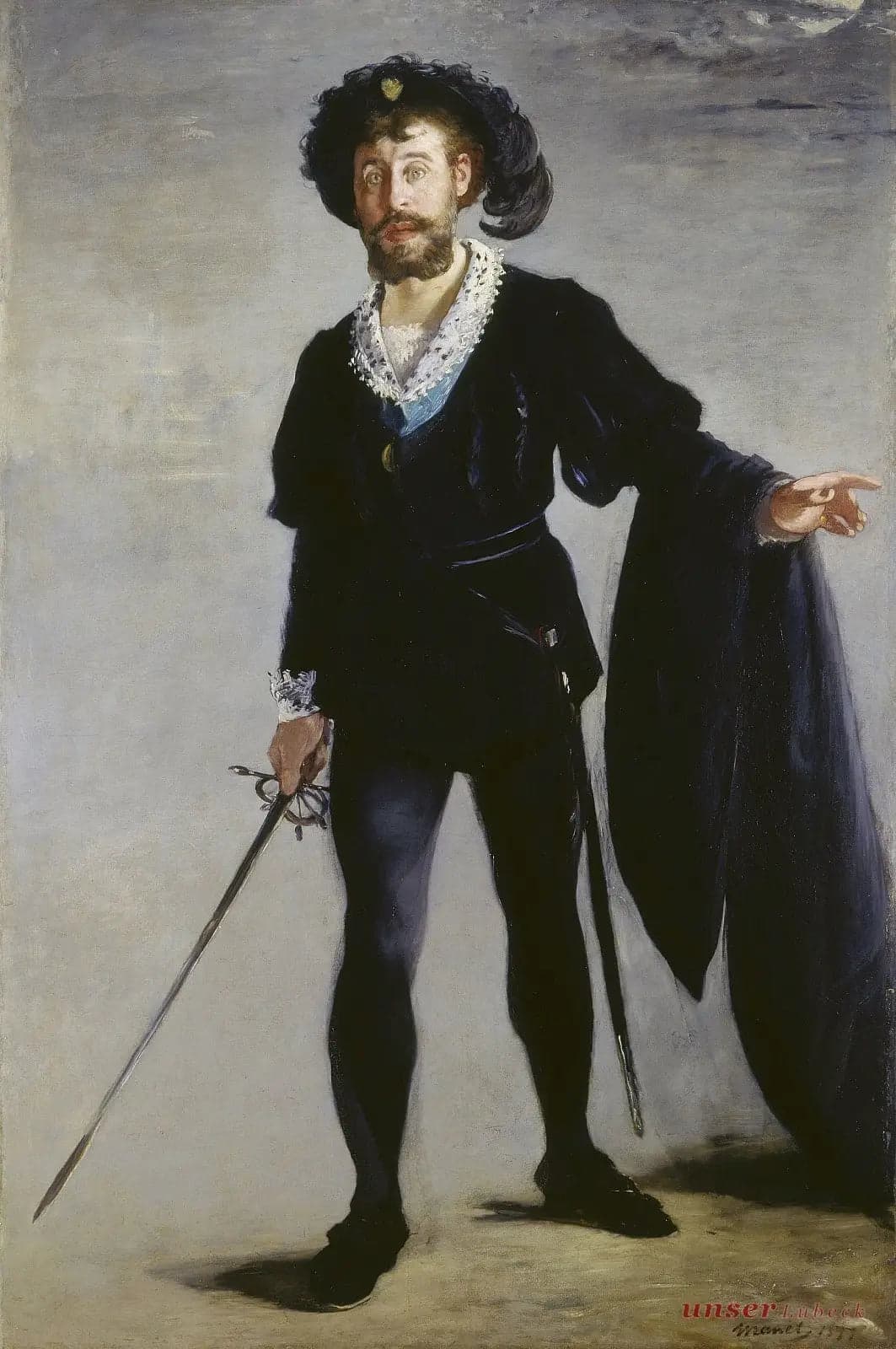
Portrait of Faure as Hamlet
- Original dimensions
- 131 x 196 cm
- Museum
- Folkwang Museum
- Year
- 1877
Scene depicted
The painting “Portrait de Faure dans le rôle d'Hamlet” depicts the actor in stage costume, a powerful moment where theatrical performance transcends mere representation. Manet captures here not only Faure's outward appearance but his very essence, his immersion in the iconic role of Hamlet. The pose, light, and shadows create a poignant dialogue between the artist, the model, and the viewer, inviting each to feel the weight of Shakespearean drama.
Historical context
This painting , created in 1877, is at the heart of the artistic revolution of the late 19th century in Paris, a melting pot of experimentation where the Impressionist movement emerges with force. The painting, now preserved at the Folkwang Museum in Essen, echoes a time when art frees itself from traditional academic constraints, paving the way for stylistic innovations. Its striking dimensions of 131 x 196 cm invite viewers to dive into a pictorial universe of rare intimacy.
Place in the artist's career
This painting is situated at a turning point in Manet's career, illustrating his transition from a more classical style to a bold and contemporary approach. At the same time, his works “Olympia” and “Le Déjeuner sur l’herbe” hint at this evolution, where the artist explores psychology and modernity through increasingly daring compositions. “Portrait de Faure dans le rôle d'Hamlet” embodies this period of maturity where emotion and innovation intersect.
Anecdote
“Art must capture the ephemeral,” said Manet. One spring morning, while walking down a sunny street, he crossed paths with the penetrating gaze of the actor Faure, interpreter of Hamlet. This face, marked by deep emotions, inspired him to create this canvas , a perfect fusion between man and tragic character. This magical encounter then becomes the very symbol of the expressive power of art.
Major exhibitions
Salon of 1877