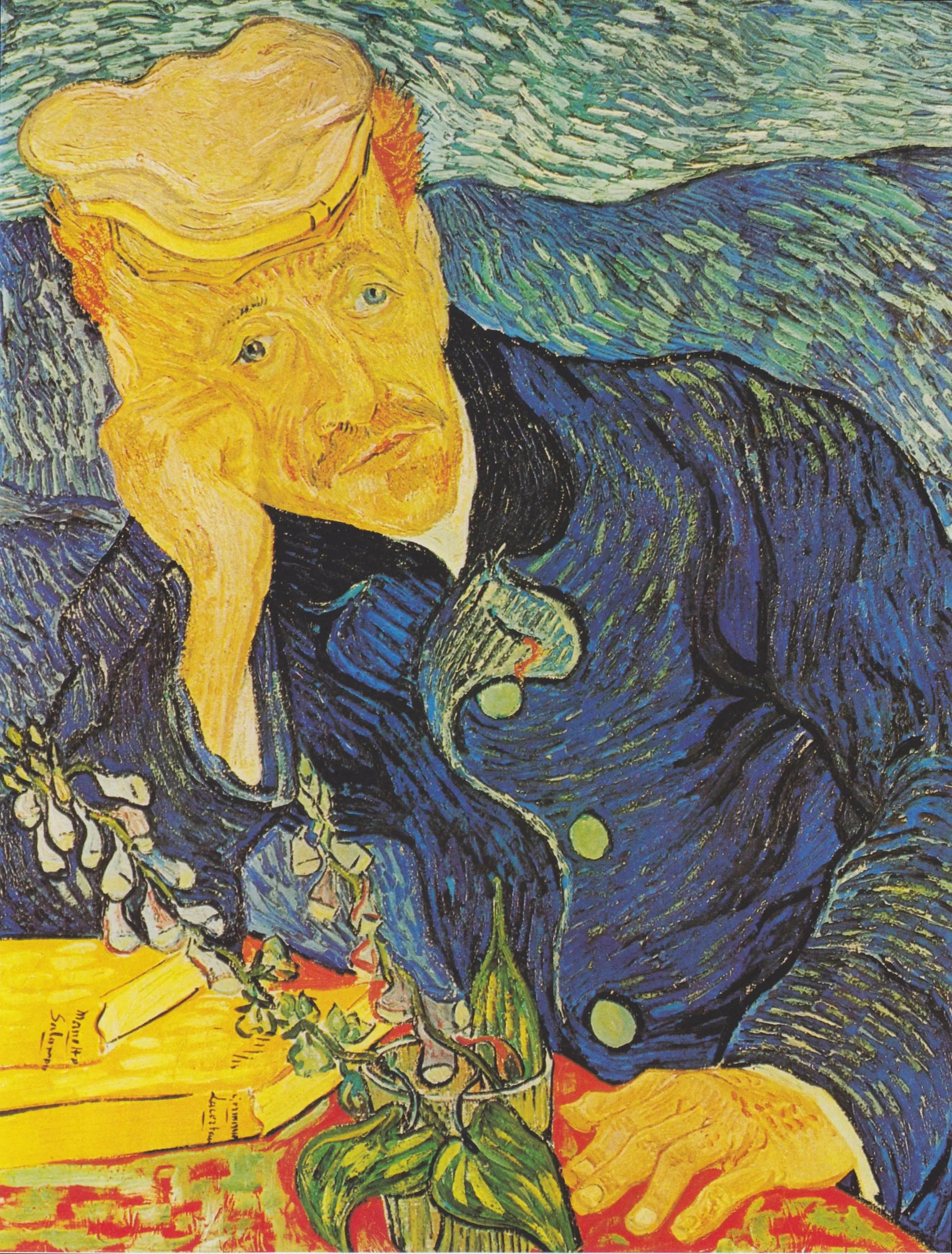
Portrait of Dr. Gachet with Foxglove Branch
Scene depicted
This painting features Dr. Gachet, a physician and art historian, wearing a melancholic yet serene expression, holding a foxglove branch, a symbol of both tranquility and poison. The harmonious composition depicts a moment of deep introspection, revealing both the vulnerability of the human being and the struggles that each person carries within. By placing such a subject on his canvas , Van Gogh poignantly immortalizes a moment.
Historical context
Created in 1890, this painting masterfully finds its origin in Auvers-sur-Oise , a village that was the last refuge of Vincent van Gogh before his tragic death. A prominent member of the Impressionist movement, Portrait of Dr. Gachet with Foxglove embodies not only the essence of a tormented artist but also the quintessence of an era when art was committed to capturing raw emotion. This painting is currently displayed in a collection of "degenerate art," highlighting its importance in the history of modern art. With dimensions of 56 x 66 cm, this canvas instantly attracts the eye and the mind.
Place in the artist's career
Portrait of Dr. Gachet with Foxglove represents a turning point in the career of Vincent van Gogh . This painting belongs to the late period of his work, where emotional intensity and gestural technique are at their peak. In parallel with works like The Sunflowers and The Starry Night , this canvas reveals an evolution in his perception of the world, extending from vibrant nature to portraits laden with sensitivity.
Anecdote
“The illness of the soul needs care just as much as it needs colors.” This quote perfectly summarizes the life of Vincent van Gogh and his deep connection with Dr. Gachet, his friend and doctor. Imagine that sunny morning in Auvers-sur-Oise , where Van Gogh captured on his canvas the very essence of a man he admired. This face-to-face encounter between the painter and the subject transformed into a masterpiece vibrant with humanity and sensitivity.