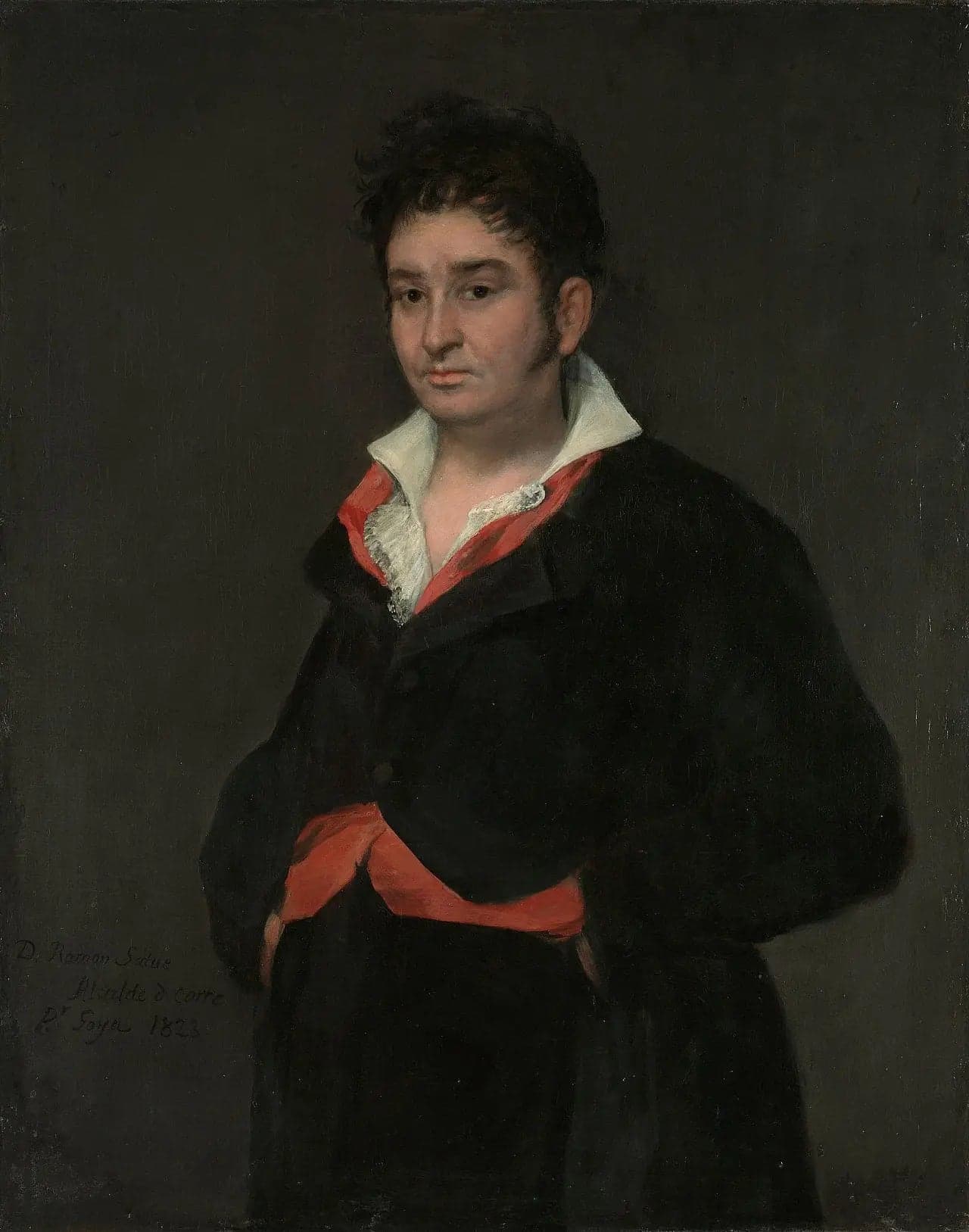
Portrait of Don Ramón Satué
- Original dimensions
- 81.3 x 104 cm
- Museum
- Rijksmuseum
- Year
- 1823
Scene depicted
The painting “Portrait of Don Ramón Satué” captures a moment suspended in time, depicting an elegant man in traditional Spanish clothing. His gaze, both stoic and contemplative, conveys a profound humanity. Goya, through his masterful technique, succeeds in conveying the very essence of his subject, awakening lasting curiosity and deep admiration.
Historical context
Created in 1823, this painting is the result of the embrace between the twilight of the Spanish Golden Age and the emergence of romanticism . Located in Amsterdam, this work marries the glow of the past with rising artistic revolutions. The canvas is currently housed in the prestigious Rijksmuseum , a sanctuary of masterpieces where every detail tells a story of heritage and passion. Its dimensions, 81.3 x 104 cm, give it a striking presence that captures the eye and the heart.
Place in the artist's career
This canvas represents a milestone in Goya's career, situated at the intersection of a time of political and artistic turmoil. By relating it to “The Clothed and Unclothed Majas” and “The Charge of the Mameluke,” one observes a stylistic and emotional evolution, where Goya, far from being a mere portraitist, also asserts himself as a sharp commentator on society.
Anecdote
“Art is a mirror of our souls,” said Goya, inspired with every brushstroke by the life around him. Imagine him, one spring morning, wandering through the sunlit streets of Madrid, crossing the gaze of Don Ramón Satué, a figure imbued with dignity and mystery. This fleeting moment became the beating heart of his masterpiece , a canvas vibrant with life.