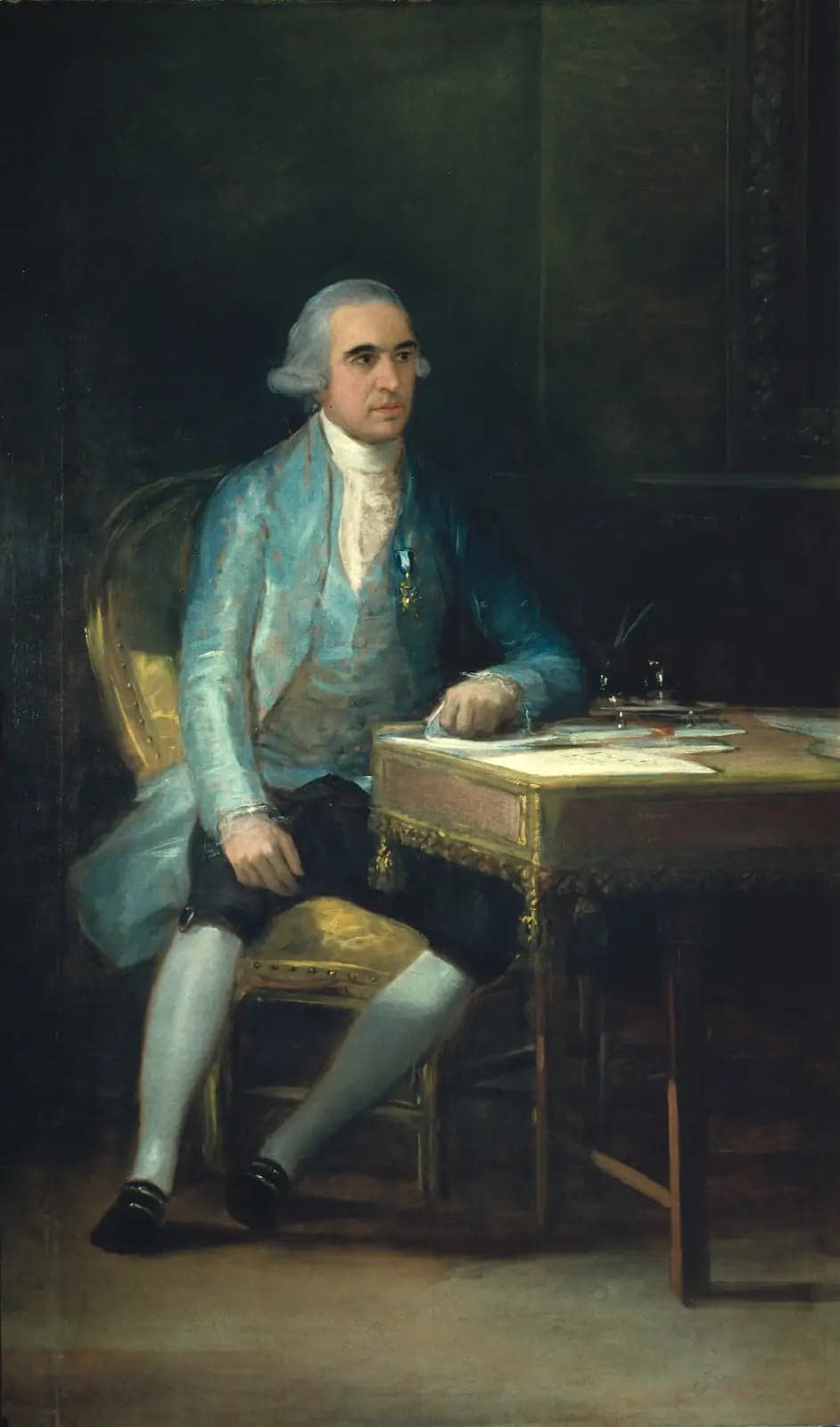
Portrait of Don Francisco de Saavedra
- Original dimensions
- 118 x 196 cm
- Museum
- Courtauld Gallery
- Year
- 1798
Scene depicted
The painting immortalizes Don Francisco de Saavedra, a man of letters and politician, whose portrait reveals not only his social status but also the depth of his soul. In this work, Goya explores the nuances of power and dignity, often undermining the stereotypes of the nobility of his time. The face, enriched with masterful details, tells a timeless story of loyalty and melancholy.
Historical context
Created in 1798, this painting embodies life in the heart of Spain, at a time marked by a vibrant artistic movement. Francisco de Goya , an iconic figure of Spanish romanticism , captures the essence of a troubled yet creatively rich era. The canvas is currently displayed at the Courtauld Gallery in London, a precious treasure of our artistic heritage that fascinates visitors with its imposing dimensions.
Place in the artist's career
The Portrait of Don Francisco de Saavedra marks a turning point in Goya's career, a true pinnacle of his period of artistic boldness. Alongside other works such as the Portrait of the Duchess of Alba and The Executions of May 3rd, this painting showcases his unique style, revealing a clear evolution in his technical and emotional approach towards more intense and captivating compositions.
Anecdote
“I paint what I feel, not what I see.” This phrase resonates in each brushstroke that outlines the face of Don Francisco de Saavedra. This canvas was created on a sunny morning at the end of the 18th century, where the air was filled with promises of the future. The inspiration sprang from a chance encounter in the royal gardens, bringing to life the intensity of a gaze that captures humanity in all its complexity.