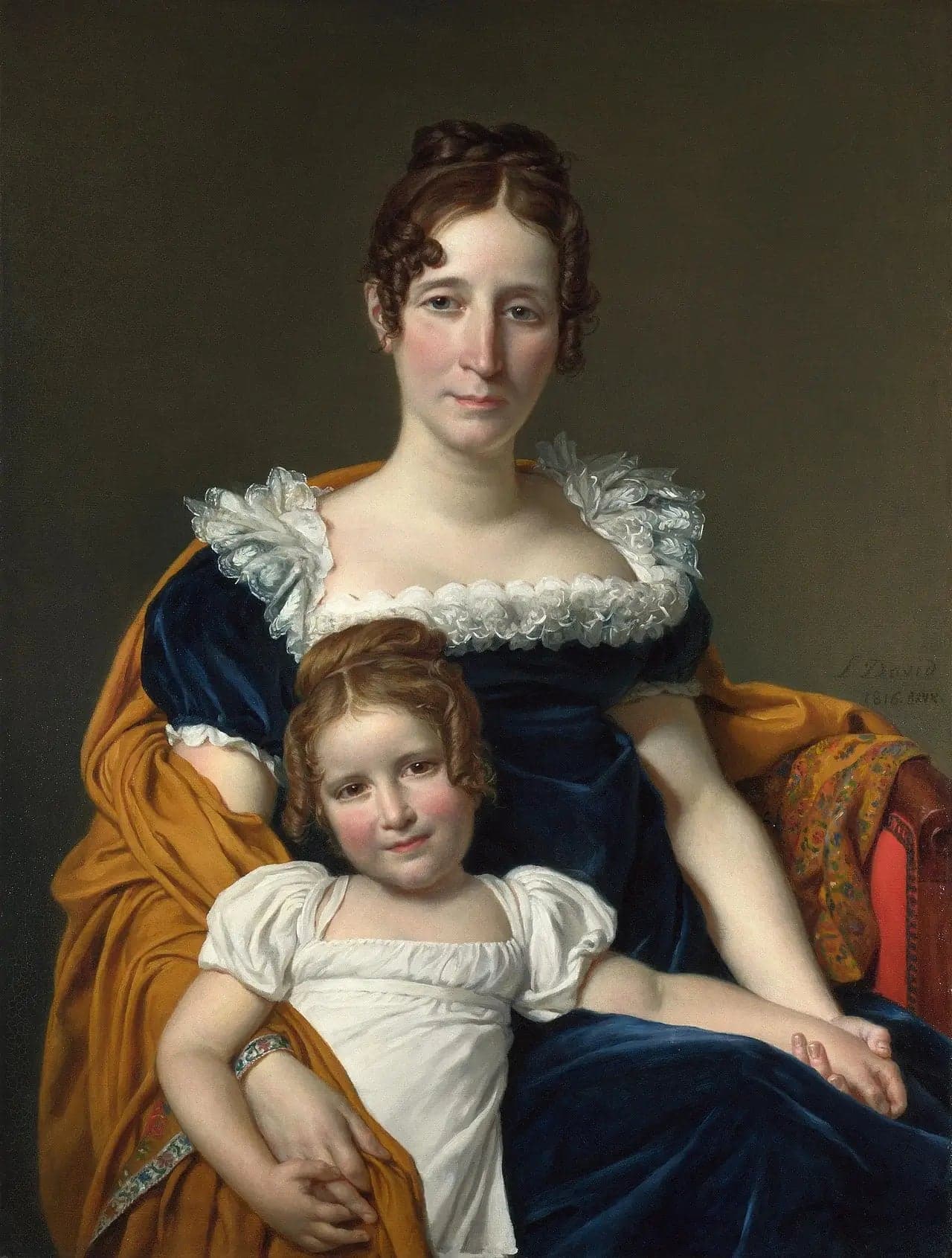
Portrait of Countess Vilain XIIII and her daughter Louise - Jacques
- Original dimensions
- 76 x 95 cm
- Museum
- National Gallery
- Year
- 1816
Scene depicted
This painting, "Portrait of the Countess Vilain XIIII and Her Daughter Louise," depicts the intimacy of a mother and her daughter, expressing deep bonds through a harmonious composition. The delicacy of Louise's face, surrounded by a mist of elegance, evokes familial tenderness. The rich and ornate background reveals the status and presence of the Countess, offering a striking view of their inner world.
Historical context
Created in 1816, this iconic painting by Jacques-Louis David is part of the neoclassical movement. In London, at the heart of the National Gallery, the work is housed in a setting that beautifully illustrates the artistic expression of this era. The canvas reflects noble sentiments, often heightened by a masterful chiaroscuro, characteristic of David's art.
Place in the artist's career
This painting represents a central milestone in David's career, illustrating his mastery and ability to capture human nuances. It is part of a series of masterpieces, such as " The Oath of the Horatii " and " The Death of Socrates ", showcasing the subtle evolution of his style and the depth of his pictorial emotions that define his work.
Anecdote
Jacques-Louis David once stated: "Beauty lies in truth, and truth must always be embodied in painting." It is in this quest for artistic sincerity that he painted this portrait. Imagine a spring morning, where the sun's rays filter through the windows of a silent studio, the scent of flowers awakening the inspiration of an artist in search of immortality through painting.