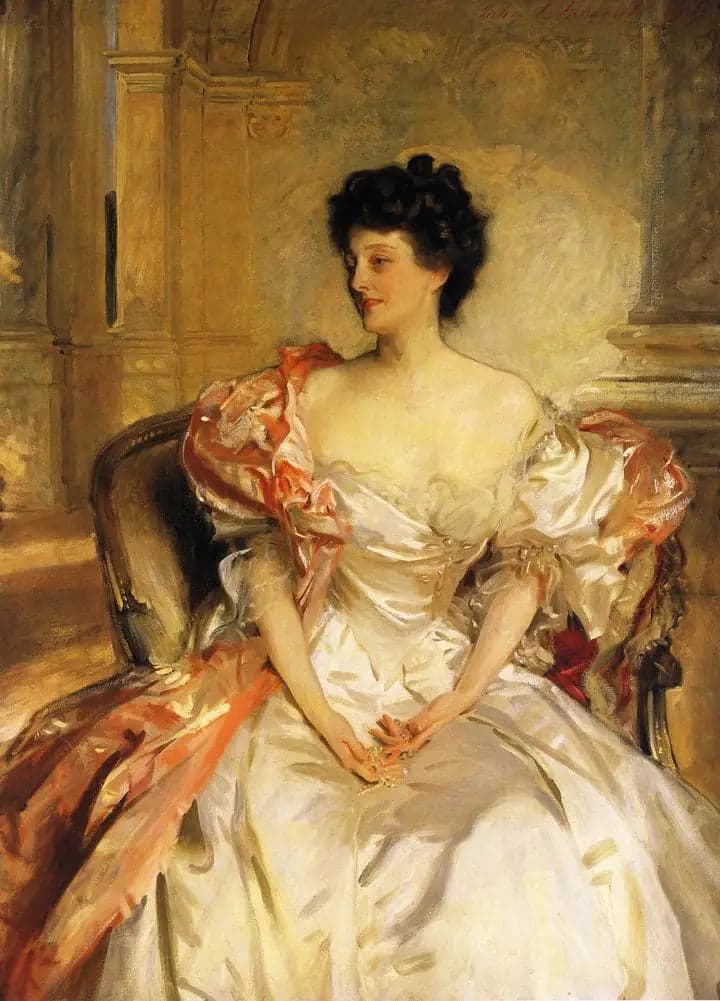
Portrait of Cora Elizabeth Smith Colgate Kennard, briefly Countess of Strafford
- Original dimensions
- 113 x 157.5 cm
- Museum
- Heytesbury House
- Year
- 1908
Scene depicted
This painting reveals a woman of striking beauty, embodying the grace and elegance of her time. The viewer is drawn into a universe where Cora's deep gaze seems to engage in a silent dialogue with those who contemplate it. Sargent's mastery is expressed here through a subtle play of light and shadow, enhancing the psychological depth of his model and the richness of the canvas .
Historical context
Created in 1908, this painting emblematic of John Singer Sargent is the result of exceptional talent, rooted in the impressionist movement. Located at Heytesbury House, this work aims to reflect an era where light and color transform reality, providing a conducive setting for the emergence of this painting that will leave a lasting impression.
Place in the artist's career
This Portrait of Cora Elizabeth Smith Colgate Kennard marks a major turning point in Sargent's career, illustrating his innovative approach and ability to capture the very essence of his subjects. Compared to his other works, such as "Madame X" or "El Jaleo", one can observe an evolution in the way he examines the emotional complexities of human personality through the paintings he creates.
Anecdote
John Singer Sargent once stated: “Every portrait that is painted with love is a kind of piece of magic.” That morning, bathed in the golden lights of an English spring, the encounter with Cora, a living light herself, inspired the artist. This masterpiece , a fragile balance between immediately striking and delicately intimate, is born from this communion of souls between the artist and his subject.