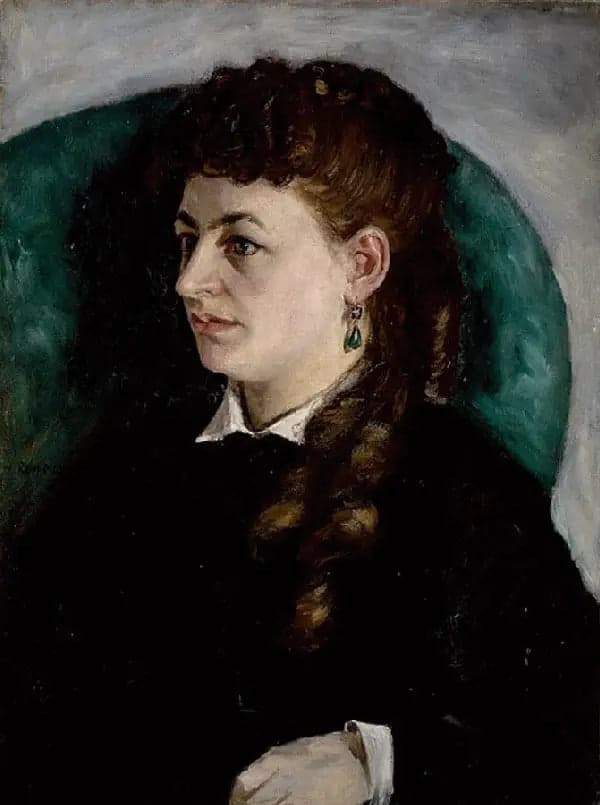
Portrait of Clémence Tréhot, known as Mme Jules Le Cœur - Pierre
- Original dimensions
- 46 x 61 cm
- Museum
- Kunstmuseum Basel
- Year
- 1866
Scene depicted
This painting illustrates a moment suspended in time, where the beauty of Clémence Tréhot, carried by Renoir's affection, reveals itself. The artist manages to transcend the simple portrait, offering a vibrant staging, where every detail, from the glow of her skin to the fineness of her clothing, evokes a rich inner life full of promises. The artwork evokes love, tenderness, and the human bond in all its splendor.
Historical context
Created in 1866, this iconic work is at the heart of Impressionism , an artistic movement born in France, particularly in Paris, during the 19th century. In a context where light, colors, and emotions took precedence over strict realism , this painting is now housed in the Kunstmuseum Basel, testifying to a time when art became a profound sensory experience. The painting measures 46 x 61 cm, an ideal format to accommodate the delicacy of the artwork .
Place in the artist's career
This portrait , which represents a turning point in Renoir's career, is part of a period of intense exploration. Not far from works such as “Le Bal du Moulin de la Galette” and “Les Baigneuses,” this piece testifies to an unprecedented exploration of light and forms. It reveals the maturity of an artist devoted to the ephemeral beauty of life.
Anecdote
“The beauty of a face is what drives me to paint,” Renoir might have said while reminiscing about the creation of this masterpiece . Imagine him sitting at his easel, one spring morning, capturing the sparkle in Clémence's gaze, where a soft light mingles with the shadows of nearby trees, creating an intimate and charming atmosphere.