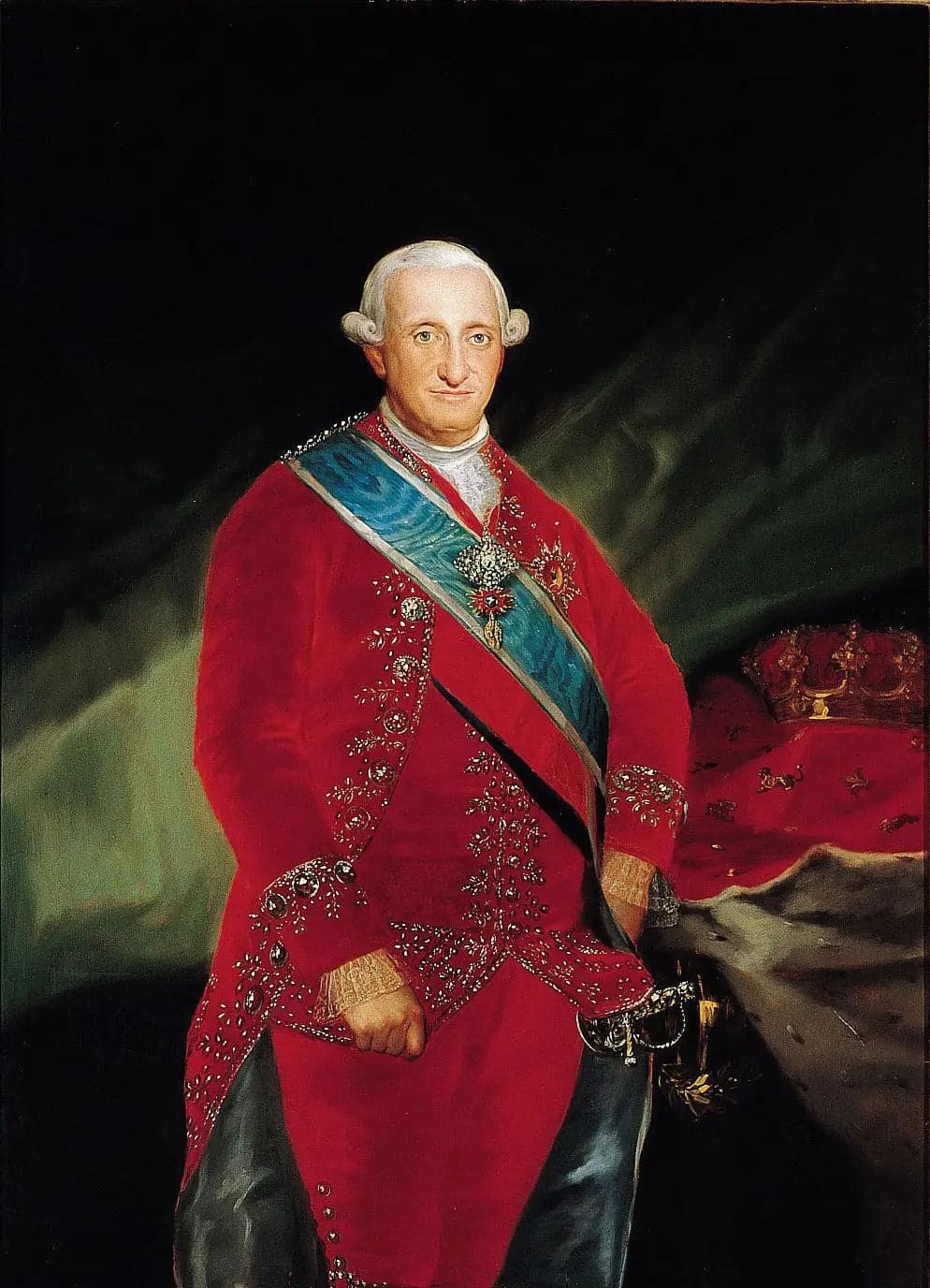
Portrait of Charles IV of Spain
- Original dimensions
- 129.5 x 171.5 cm
- Museum
- Royal Academy of History
- Year
- 1789
Scene depicted
The painting depicts King Charles IV surrounded by his family, his posture and gaze conveying a quiet authority. Goya, in true harmony with his subjects, captures not only their features but also their essence. The composition, both solemn and intimate, reflects a moment where royalty is laid bare, where the human being intertwines with the image of power.
Historical context
Created at the end of the 18th century, this painting is emblematic of the artistic movement of romanticism . Made in Madrid, this canvas evokes a crucial part of Spanish history, marked by the clash between tradition and modernity. Today, the painting is preserved at the Royal Academy of History, where it embodies the cultural wealth of Spain, inviting every visitor on a journey through time.
Place in the artist's career
This painting is at the heart of Goya's career, marking a period of great maturity. In parallel with works like “La Maja desnuda” and “The Executions of May 3rd,” the painting shows us the artist's technical evolution, moving from romantic representation to a more introspective approach, where the psychology of the characters is highlighted.
Anecdote
Francisco de Goya once stated: “Light and shadow dance on the canvas, revealing the soul of those who are there.” It is in this quest for authenticity, through the soft light of a spring morning, that he saw the face of Charles IV take shape. This privileged moment allowed him to infuse an evocative power into his painting , where each brushstroke carries a story to tell.