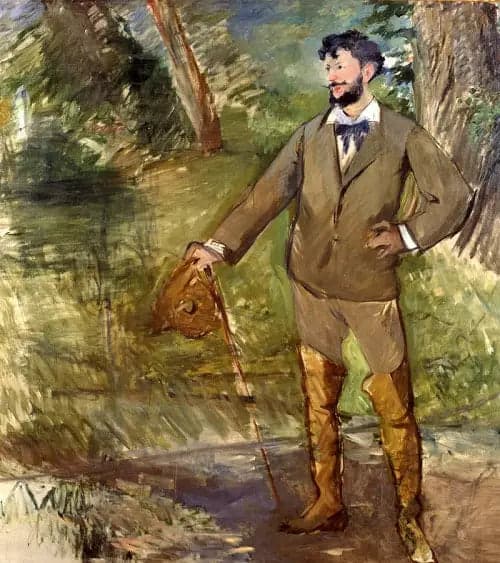
Portrait of Carolus-Duran
- Original dimensions
- 172.7 x 191.8 cm
- Museum
- Barber Institute of Fine Arts
- Year
- 1876
Scene depicted
In the painting “Portrait of Carolus-Duran,” Manet depicts an admired artist, in full concentration, ready to transcend the limits of the canvas. The dark background and skillful play of light highlight the model's face, while the posed attitude takes the viewer into a delicate introspection. This pictorial work, both strong and hidden in shades of black and cream, speaks of dynamic creativity and an era in full effervescence.
Historical context
Created in 1876, this painting emblematic finds its roots in the vibrant Paris of an era when impressionism begins to sketch the features of modern art. Located today at the Barber Institute of Fine Arts , this canvas testifies to a major artistic transition, boldly blending realism and personal expression in the world of painting.
Place in the artist's career
This masterpiece marks a crucial milestone in Manet's career, allowing him to assert his innovative pen. Alongside “Le Déjeuner sur l’herbe” and “Olympia,” this painting reveals the evolution of his style, a journey towards a freedom of expression that will redefine the art of his time. Far from being a mere reproduction of reality, “Portrait of Carolus-Duran” becomes a symbol of artistic innovation.
Anecdote
Édouard Manet is said to have declared one day: “Art is a mirror of life, it must capture the light of an era, even in the shadow.” It is on a quiet spring morning in Paris that the artist meets his model, Carolus-Duran, whose sharp and thoughtful gaze deeply inspired the evocative power of this painting . The canvas captures not only his image but also the intensity of a suspended moment.