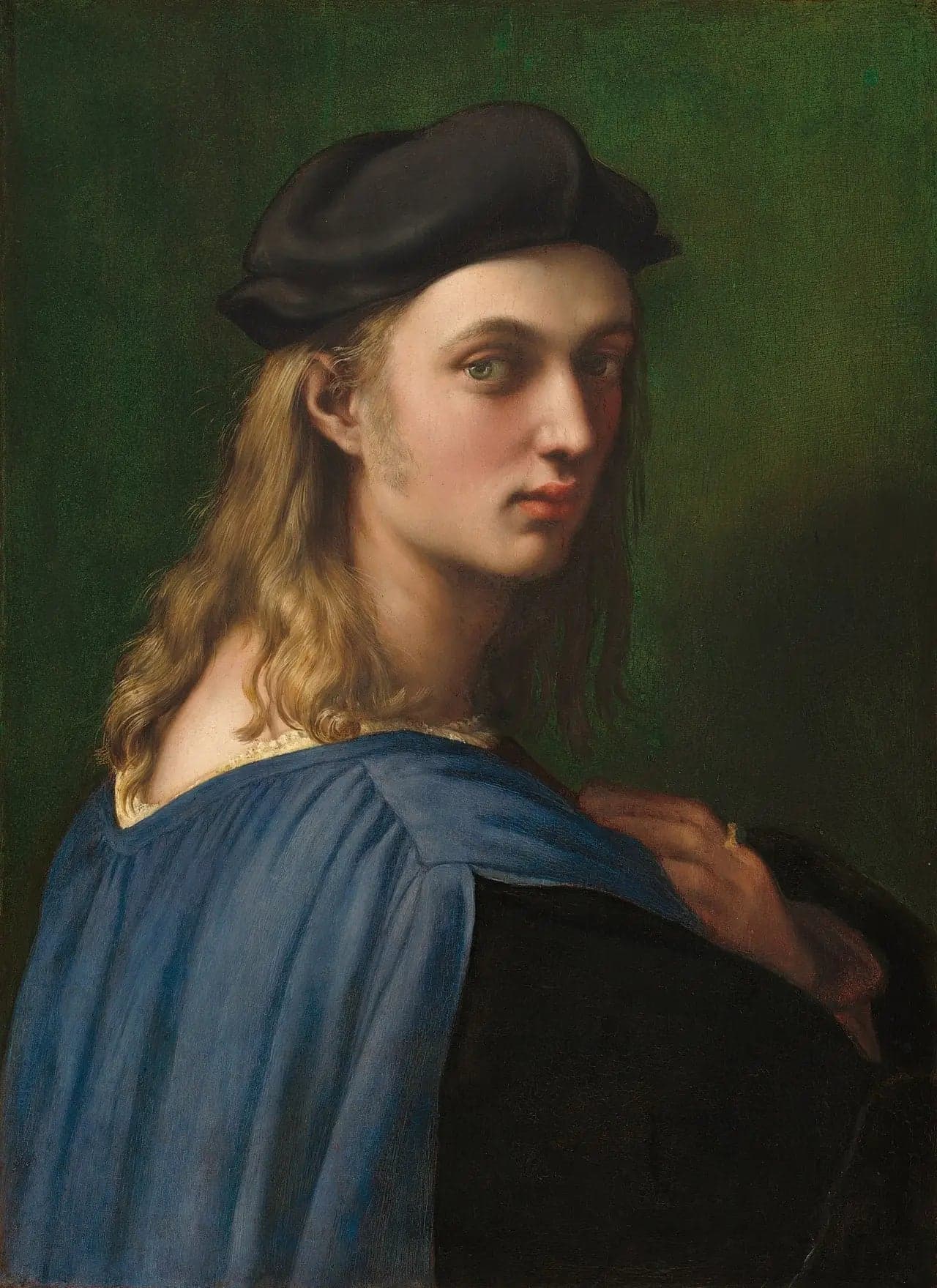
Portrait of Bindo Altoviti
- Original dimensions
- 43.8 x 59.7 cm
- Movement
- High Renaissance
- Museum
- National Gallery of Art
- Year
- 1515
Scene depicted
In the painting “Portrait of Bindo Altoviti,” Raphael captures the essence and personality of the Florentine nobleman. This portrait, imbued with dignity and simplicity, depicts a man with a penetrating gaze, where light gently caresses his features, revealing a profound and touching humanity. The dark background contrasts with the clarity of his face, enhancing the composition and immersing the viewer in a heart of silent introspection.
Historical context
This painting was created in 1515, at the heart of the Italian Renaissance , an unprecedented artistic and cultural surge. The painting, currently displayed at the National Gallery of Art in Washington D.C., reflects a period when art transcends boundaries and is enriched by an ideal of timeless beauty, the result of remarkable craftsmanship and an innovative vision.
Place in the artist's career
The portrait of Bindo Altoviti is part of a pivotal phase in Raphael's career, illustrating his growing mastery of light and forms. In parallel, one can mention the painting “The Sistine Madonna” and “Pope Julius II,” two works that mark the evolution of his style, always imbued with a quest for beauty and harmony.
Anecdote
Raphael, in a moment of deep contemplation, is said to have murmured: “The beauty of a face is a dance of light and shadow.” This sentiment was inspired one radiant morning in the streets of Florence, as he caught sight of a delicately featured face, which painted the masterpiece of Bindo Altoviti with palpable emotion.