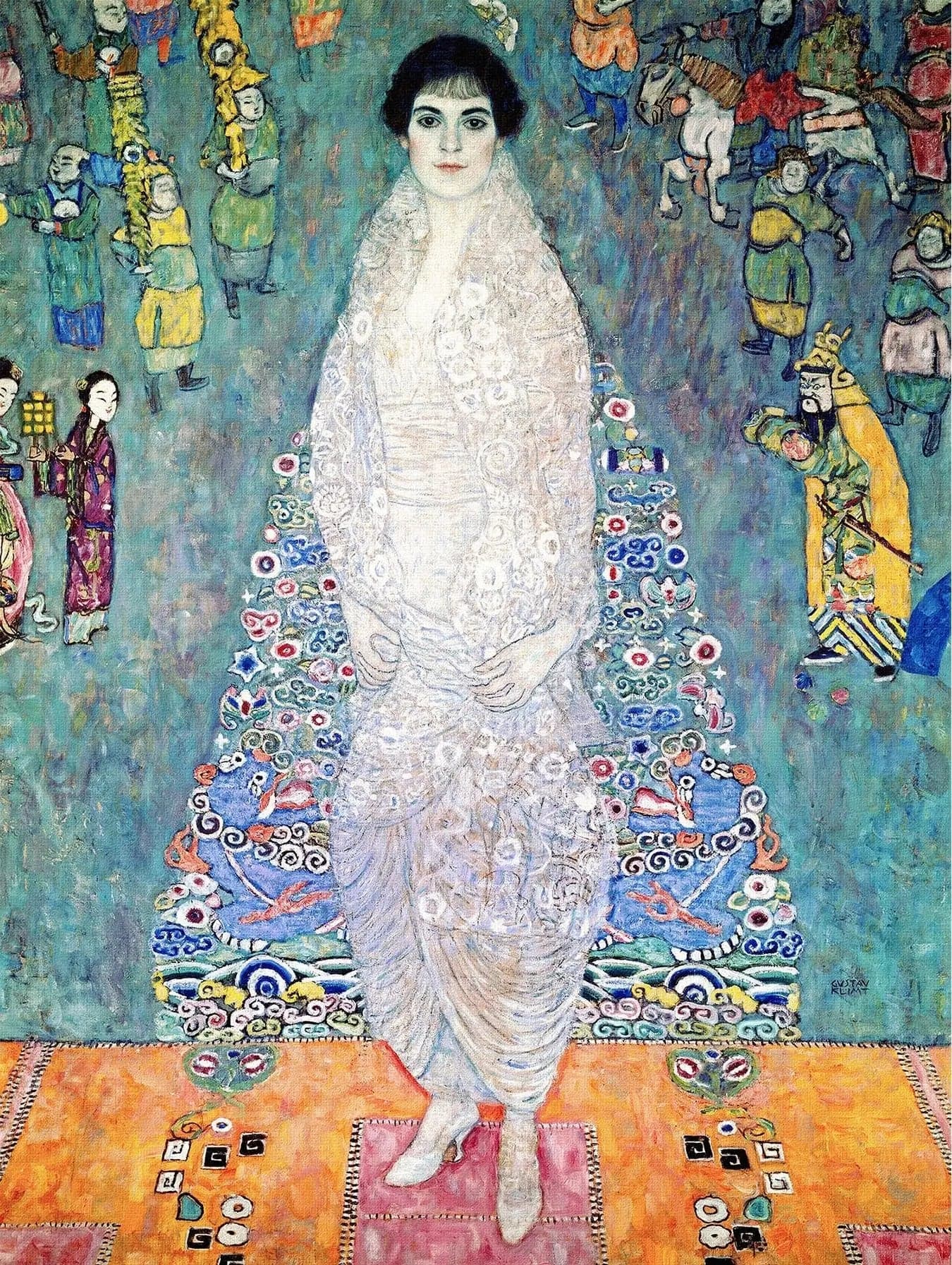
Portrait of Baroness Elisabeth Bachofen-Echt
Scene depicted
This pictorial work reveals to us the graceful silhouette of Baroness Elisabeth, wrapped in golden drapery, a luminous complexion contrasting with the abstract and richly adorned background. The composition plays with floral and organic patterns, creating an atmosphere of luxury and intimacy, where every detail is carefully crafted to convey the elegance and strength of its subject.
Historical context
Created in 1907, this painting emblematic takes its roots in Vienna, at the heart of Austria, where modernism and Art Nouveau flourish. This canvas , now preserved at the Neue Galerie New York , is part of the artistic movement of Austrian Secession . This movement, bold and avant-garde, reflects an inventive era, where art becomes an act of rebellion and self-assertion.
Place in the artist's career
The canvas Portrait de la baronne Elisabeth Bachofen-Echt represents a peak in Klimt's career, demonstrating his distinctive style and technical evolution. Compared to canvases such as The Kiss and The Lady in Gold , this painting illustrates a period of maturity where Klimt exploits the richness of gold and textures, revealing the narrow lines between emotion and ornamentation.
Anecdote
“Every portrait is a meeting, and every meeting a reflection of the soul,” could have said Klimt , undoubtedly inspired one sunny morning in Vienna. The authenticity of the baroness's face, crossed by a simple chance in a blooming garden, allowed him to express the thousand and one nuances of femininity. This vibrant emotion is found in the painting , capturing the very essence of his model.