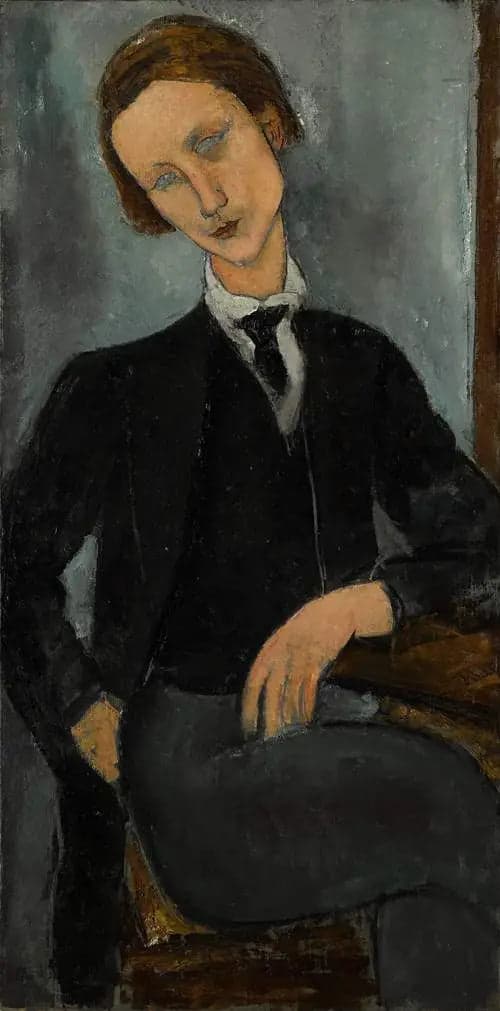
Portrait of Baranowski
- Original dimensions
- 47 x 62 cm
- Museum
- De Young Museum
- Year
- 1918
Scene depicted
The painting stands out for its unique approach to proportions and forms. Modigliani, with his inimitable style, offers a stylized vision of Baranowski. The painting shows an elegant man, capturing both the depth of his gaze and the texture of his suit. Each brushstroke seems to narrate a story, revealing the complexity of the human soul. Thus, the composition is not simply about representing a face: it evokes a deep and touching narrative.
Historical context
Created in the heart of the intense artistic period of the 1910s, within the vibrant city of Paris, Portrait de Baranowski is part of the modern movement, characterized by its innovations both stylistically and thematically. It is a time when cubism and fauvism profoundly influence artists. The canvas is currently housed in the illustrious De Young Museum in San Francisco, a sanctuary of modern art that venerates this magnificent painting .
Place in the artist's career
Portrait de Baranowski represents a pivotal moment in Modigliani's career. It is a turning point where his style undergoes significant maturation. Compared to other iconic paintings like Nu couché (1917) and Femme assise (1918), this work illustrates a remarkable evolution towards impressive abstraction blending psychological depth and formal beauty.
Anecdote
“Capturing the essence of a face is like grasping the soul of a melody,” Modigliani often said when speaking of his portraits. That morning, in Montparnasse, a light scent of spring flowers floated in the air. Upon meeting the gaze of Baranowski, a mysterious man known for his passion for art, Modigliani was struck by his charisma. This became the spark that ignited his reflection, inspiring him to create this masterpiece .