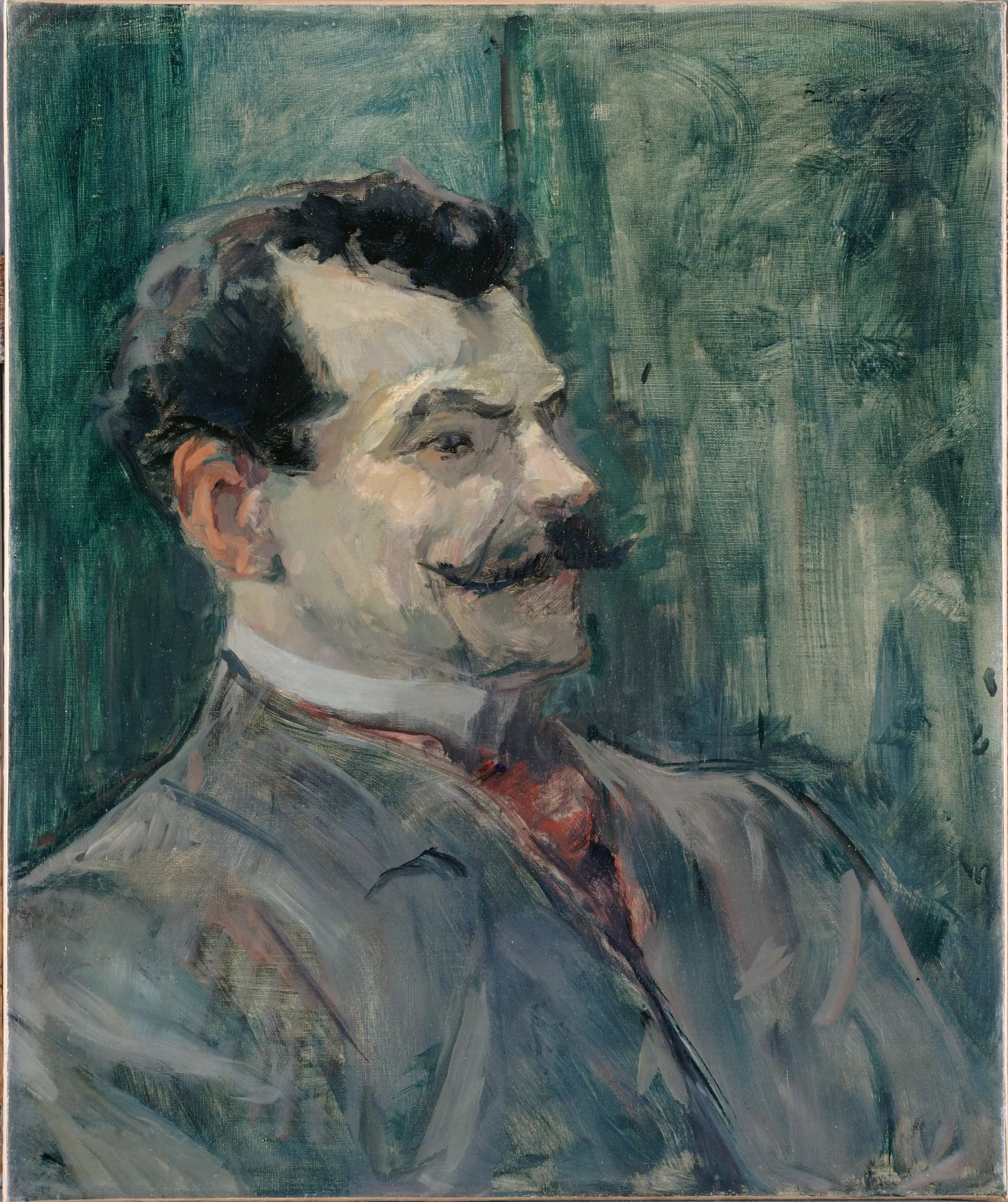
Portrait of André Rivoire - Henri de Toulouse
- Original dimensions
- 46 x 55 cm
- Museum
- Petit Palais
- Year
- 1901
Scene depicted
The painting offers us an intimate and incisive glimpse into the character of André Rivoire, a fascinating figure of Parisian society. By capturing his expression and the subtleties of his attitude, Toulouse-Lautrec testifies to the humanity of the individuals he painted, making this painting emblematic of his fundamental quest for artistic truth.
Historical context
Created in 1901, in the vibrant city of Paris, this painting is part of the artistic movement of post-impressionism . It was a time when the city of light radiated creativity and imagination, providing artists like Toulouse-Lautrec with a perfect backdrop to develop their craft. Today, this canvas is preserved at the Petit Palais , an art gem in the heart of the French capital.
Place in the artist's career
The Portrait of André Rivoire marks a milestone in Toulouse-Lautrec's career, illustrating his mastery of portraiture and laying the groundwork for his artistic legacy. In parallel, works such as “Jane Avril” and “At the Moulin Rouge” testify to his technical evolution, linking his distinctive style to an ever-growing emotional depth.
Anecdote
Henri de Toulouse-Lautrec once stated: “Beauty is a matter of light and shadow.” Inspired by the faces encountered in the bustle of Montmartre, he captured this precise moment to immortalize André Rivoire. In this masterpiece , the painter's palpable passion resonates, while the memory of a spring light illuminates the canvas .