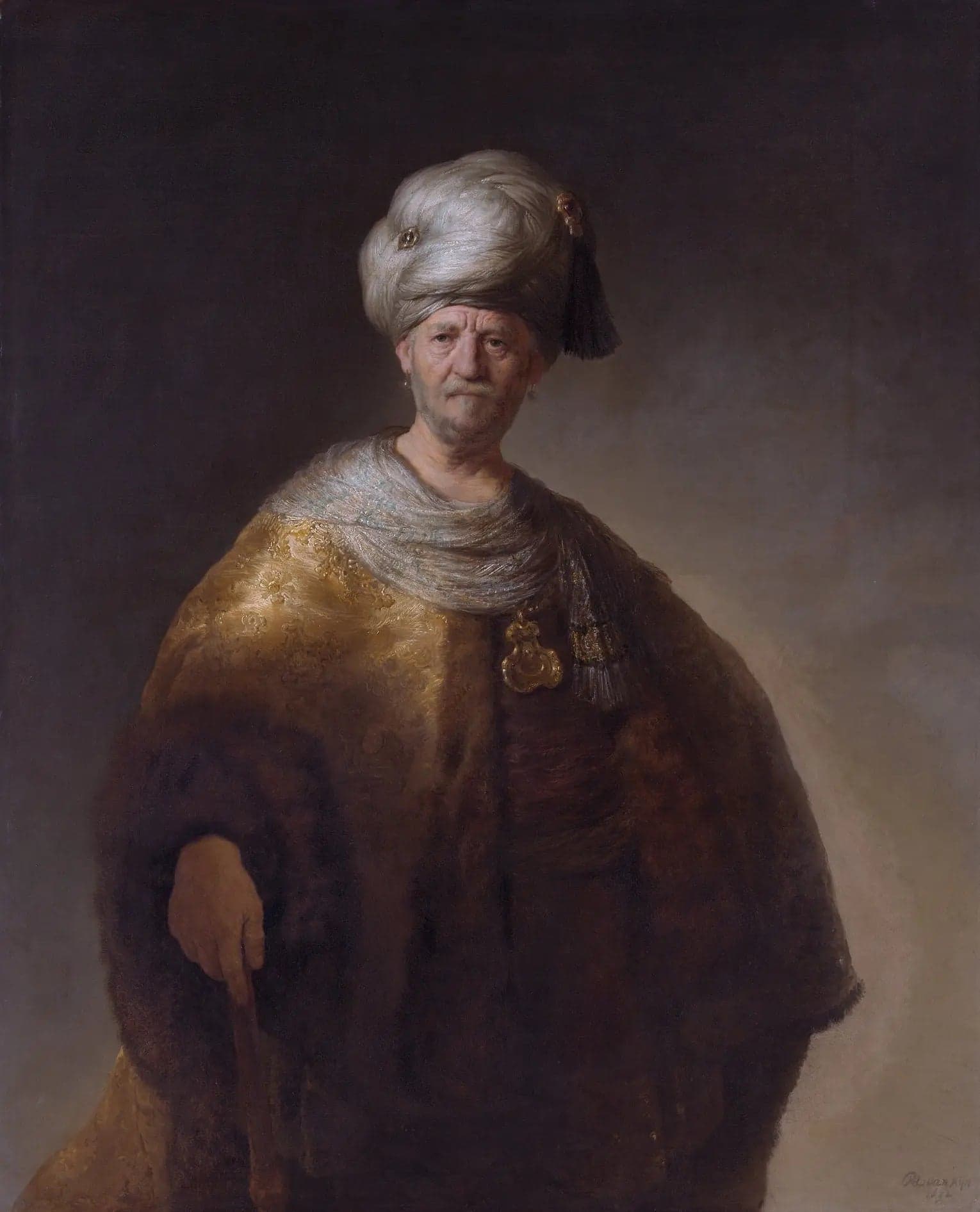
Portrait of an Oriental Noble
- Original dimensions
- 111.1 x 152.7 cm
- Movement
- Dutch Golden Age of painting
- Museum
- Metropolitan Museum of Art
- Year
- 1632
Scene depicted
In this iconic painting, Rembrandt takes us into the vast and rich universe of oriental culture. The nobleman, dressed in sumptuous attire, seems to believe in a suspended moment, while his distant gaze reveals a depth of soul. The way light caresses the folds of his clothing and illuminates his face testifies to Rembrandt 's genius in the art of playing with shadows and light. This painting is much more than a simple representation; it is an invitation to question identity and cultures.
Historical context
Created in 1632, this masterful work by Rembrandt comes to life in Amsterdam, a city that, during the Dutch Golden Age of painting, became the center of an unprecedented artistic flourishing. The painting is currently housed at the Metropolitan Museum of Art , a venerable institution in New York, and proudly measures 111.1 x 152.7 cm. Rembrandt , drawing on the techniques of his time, managed to capture the very essence of his subject, blending majesty and truth.
Place in the artist's career
This Portrait of an Oriental Noble represents a period of maturity in Rembrandt 's career, where he explores the richness of textures and emotions. By comparing it with other paintings such as "The Night Watch" and "Self-Portrait with Two Circles," one feels an evolution in the mastery of contrasts and realism . Each work reveals a different aspect of his artistic vision, but this portrait remains an emblematic signature of his unique style.
Anecdote
“I have always believed that light reveals more to us than words,” Rembrandt might have said while creating this masterpiece . Imagine a sunny morning, soft light filtering through the windows of his studio, when the captivating face of an oriental noble imposes itself on him, inspiring a canvas rooted in mystery and elegance.